
Chapter Text
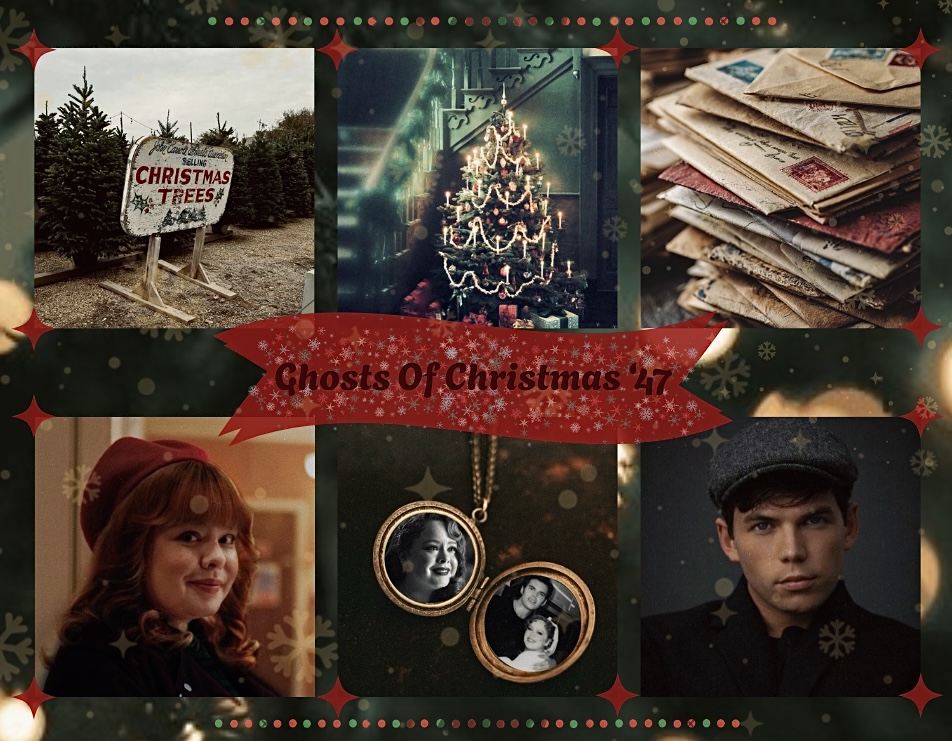
Here we are as in olden days
Happy golden days of yore
Faithful friends who are dear to us
Gather near to us once more
- Have Yourself A Merry Little Christmas, 1943
“You must make your own life amongst the living and, whether you meet fair winds or foul, find your own way to harbour in the end.”
- The Ghost and Mrs Muir
💫💫💫
Christmas Eve, 1947
Not the showiest choice, that’s for sure. Pretty, but imperfect. Weathered and leaning, a little sparse on one side; a little shaggy on another. But that’s part of its charm.
Right then. This is the one.
As he reaches into the thick tangle of green, pushing aside prickly needles to find the trunk, something familiar brushes the air—oranges and rich, cedary pipe smoke—warmth cutting through the knife-cold December morning. The scent hits him with an ache so sharp his breath stutters.
Father.
Colin smiles, a little bit melancholy, a little bit cradled. He treasures what he has come to regard as godwinks, reminders that Edmund Bridgerton remains with his loved ones in spirit, his legacy still making its mark even if his feet no longer leave prints on the ground.
Infrequent and fleeting though these moments are, they are always inexplicably right on time. There in the dark hours when Colin has needed them most. A foxhole in Calais. A midnight filing room in Brussels under shellfire. And now, a tree lot on Christmas Eve, his first holiday back in London after a long time away.
He closes his hand around the trunk, but instead of bark and sap, his fingers brush a hand beneath time-tired wool, heat bleeding through threadbare stitches.
“Oh!” a woman gasps.
A hat-covered head appears through the curtain of evergreen branches, lush copper curls spilling forward with the tilt of her head.
He’d know that hair anywhere.
“Pen?” he asks, letting go of the evergreen. “Is that you?”
It’s December 24, 1947–the first holiday season since the blackout ended, and he’s been stumbling through fog for months. Then he sees her standing among the evergreens, the air sharp with fresh-cut pine, coal smoke, and the faintest thread of orange.
His first glimpse of her is like being jolted awake, every nerve sparking, like kindling catching and rushing into flame.
Emerging from a lonely shell.
Alive.
“Colin Bridgerton!” She releases the tree and plants her hands on her hips, a wry smile stretching across her face. “Of all the tree lots in the city, you walk into mine.”
The sound of her voice, tart and teasing, has him rocking back on his heels. Time melts away, if only for a moment.
“Ah, so you come here often?” he asks, committing to the bit.
“Only when I’m on the hunt for the imperfect blue spruce.” She brushes her mittened hand over a branch, making the needles quiver in the snappy air. “You?”
“First timer,” he jokes, dropping briefly into his Humphrey Bogart impression. Whisky poured over gravel, as someone once described Bogart’s voice. “S’pose I need an expert. What should I be looking for, kid?”
“‘Kid’ is it?” She lifts her pretty copper eyebrows. “Next thing I know, you’ll be calling me sweetheart.”
Sweetheart. Oh, how he wishes.
“I already have a nickname or two for you, don’t I?” he says lightly.
Pen. Love. And while these days, “love” is bantered about with a friendly albeit detached affection, his feelings for Pen aren’t the least bit friend-like.
“Mmmhmmm,” she says too quickly, and in the next breath she sashays around to the far side of the spruce, half-hidden behind its branches. “Right. See how this one is a little patchy over here? And these straggly bits on this side?”
He hides a smile behind his gloved hand. She only babbles like this when she’s flustered.
“No good?”
“Very good. All part of its charm. Along with the crooked trunk, of course.” Her voice floats out from behind the tree, a touch breathless, as if she’s inspecting an entire forest rather than one lopsided spruce.
“My thoughts exactly. A diamond in the rough. So I’ve chosen well?” he asks eagerly.
Too eagerly. Two minutes in her vicinity and he’s already seeking her approval. Like a schoolboy or a puppy, rather than a thirty-one-year-old seasoned news correspondent and world traveler. Pathetic, Bridgerton.
Pen emerges from the other side of the tree at last, cheeks pink, excitement bright in her eyes. “By my estimation, absolutely. I’ve always had a soft spot for the ones with potential.” She circles the evergreen as if coaxing out its best qualities, looking every bit the girl he grew up with rather than a grown woman of twenty-nine. “Some might declare this little darling ugly or pass her by, but she’s just patiently waiting for someone to see her worth.”
She stops in front of him and beams, her smile deep and certain. “Every tree has a purpose, don’t you think?”
Colin lowers his gaze to the sawdust-coated ground, suddenly feeling like they’re no longer talking about Christmas trees. Words clog his throat. Every airy or funny remark he reaches for feels wrong.
“I’ve missed you, Pen,” he manages at last, and he means it. His fingers twitch with the need to reach for her, to pull her close. He stuffs his hands into his pockets to stop himself from doing something foolish.
She simply looks at him, the humour in her eyes softening into something warmer. Then, as if it’s the most natural thing in the world, she steps forward and slides her arms around his waist in a tight hug.
He freezes, then surrenders and holds her back, his eyes drifting closed as her head slots beneath his chin. She’s solid and warm in his arms, not a ghost or a memory, but real. His hands press into the delicate muscles of her back, the familiar weight of her soft body against his chest making his heart stumble.
God, how he’s missed her.
When they finally part, he’s satisfied to note he’s not the only one a little winded. He watches her from beneath his lashes while she concentrates on dusting snow off a tree branch, both of them pretending the embrace was nothing more than a friendly greeting.
“You’re a sight for sore eyes,” he says, the truth rushing out before he can stop it.
“So are you,” she murmurs, colour rising in her cheeks when their gazes lock.
And she is—familiar and changed all at once. Wearier around the edges, but still luminously Pen. Same glowing, porcelain skin. Same morning-glory eyes. Same brisk, determined walk—two steps for each of his long-legged strides. But thinner. Tired. The war is etched into the soft planes of her face and dark crescents shadow her eyes, the same as everyone they see on the street.
“Best part of my day,” he adds, unable to keep the thought to himself.
Subtle, Bridgerton. At least you didn’t tell her it’s the best part of any day you’ve had for a long, long time.
“Well,” she drawls, “it’s still early.” She ducks her head then, fussing with the overlong sleeves of a navy coat that’s seen too many winters, plucking at a loose button. He drinks her in, memorising the details, comparing her to the version he’s held in his memory.
“I’d have known you anywhere,” he says softly.
It’s true. Her scent of lavender and ink seems to cling to his coat, warming him better than a roaring fire. He could pick her out of a crowd blindfolded, no matter how much time had passed.
And quite a bit has.
Two years, eight months, and sixteen days to be exact. Their last meeting was on Penelope’s twenty-seventh birthday. The night his dreams died.
She touches the rim of her dark blue cloche. “Even with the hat? It’s all the rage this year. Makes everyone look terribly sensible.”
“You never needed help with that, love,” he says.
The way his old endearment for her rolls off his tongue makes his ears heat. He really needs to think before he speaks. But he’s never guarded himself around Pen, and the flash of her dimples tells him she doesn’t mind. That smile could brighten the whole of London. It still knocks the wind out of him; has ever since she was a bitty little thing dressed in lemon-yellow frocks, freckles scattered across her nose like someone had dusted her with sunlight.
“And you never needed help being cheeky.”
“Me?” He throws her a look of boyish innocence—then takes a proper look at her, his eyes narrowing in sudden recognition. “That’s not much of a winter coat, Pen. Where’d you get it?”
“Oxfam here in Bloomsbury. Don’t look so stricken. On me, there’s so much fabric that it’s warmer than it looks. Not all of us are giants, you know.” She waves a hand over her diminutive 5-foot stature. “I recognised it straightaway.”
“You recognised my old coat in a charity shop?” he asks with a hard swallow. “Pen…I would’ve given it to you if you wanted it that much.”
“Well,” she says, tugging on the cuff of a sleeve, “you were away. And it was there, so I took it.”
He studies her, unable to help hearing what she didn’t say. She’s right; he hasn’t been here. And he doesn’t know how to explain why. Every excuse sounds flimsy, every reason a coward’s defense. “Actually, it suits you.”
She does look adorable in it, the sleeves rolled up and tacked with neat little stitches so it fits her petite frame. The idea that Penelope would want to wrap herself against cold winter days in something that was once his deepens the ache in his heart, fissures yawning with grief over missed chances and could’ve-beens.
He wonders if her husband knows she’s wearing a coat that once belonged to another man.
A man who never quite managed to stop loving her. No matter how hard he tried.
“Thanks.” She shrugs. “I knew it was yours because the right pocket’s deeper than the left. And this,” she says in a dramatic whisper, as if letting him in on a secret. She reaches deep into the breast pocket like she’s unearthing treasure and pulls out an orange drop, its faded wrapper crinkled, the sweet inside long past saving. She slips it back into the pocket where she found it, tucked away as though returning a charm to its rightful place.
“I keep it for luck,” she explains. “Do you still carry around a notebook?”
“Guilty,” he says, patting the pocket of his brown tweed coat with a grin, “of both the notebook and the sweet tooth.”
He produces two fresh orange drops and deposits one in the palm of her mittened hand.
“Oooh, thanks,” Pen says, her eyes lighting up. “It’s been an age since I had a proper sweet.”
They unwrap their candies, the thin paper crackling like frost beneath their feet.
The orange drop tastes sharper than in pre-ration days, certainly leaner than it did when he used to sneak them from Father’s pockets and he pretended not to notice. Pen pops the sweet into her mouth and closes her eyes, making a small noise of contentment. She’s always grateful for the smallest pleasures. Things he often took for granted in his search for what’s grand and adventurous.
He’s always loved that about her—how she makes every little thing feel like a blessing. Chess matches in the garden (which she always won). Picnics on scratchy blankets with crustless jam sandwiches and tart lemonade. Reading a book over each other’s shoulder under the gnarled old oak at Aubrey Hall.
Finding joy in the small and ordinary, the way Father taught them.
“There now,” Edmund used to say, whether Colin was enjoying a biscuit, learning something new, or fixing something broken. “Don’t let the good things pass you by.”
A radio fizzes from an old shed at the edge of the tree lot, the familiar notes of Bing Crosby dreaming of snow floating through the rows of fir trees lined up like soldiers reporting for holiday duty. Little ones giggle and chase each other, weaving in and out, the evergreen army providing an instant setting for tag or hide-and-seek. Families—both prosperous and plain—chatter with animated excitement about decorations and tonight’s visit from Father Christmas, sipping cups of hot Bovril between good-natured bartering over which tree they’re taking home.
He smiles at the living, breathing picture postcard. No matter how tight things are, everyone manages to find money for a Christmas tree.
While Penelope looks over the tree lot, grinning at a pigtailed little girl sitting on her papa’s shoulders, he studies her small hands. Her mittens are a cheerful red knit, thick and warm despite the careful darning at the fingertips. But isn’t that what they do these days? Patch and stitch and mend. Make do and carry on.
The wool covers her ring finger, and he finds himself absurdly grateful for the mystery, for the opportunity to extend their banter like it’s old times.
“Do you and your…uh, do you live around here?”
Subtle again, Bridgerton. Small wonder that intelligence hasn’t tapped you for a career in espionage.
The clerk, a cherry-nosed man bundled in a green scarf too long for his frame, glances between them with a knowing look. “Sweethearts?” he asks kindly. His spectacles are fogged over with the cold; he removes them and mops the glass with a starched white handkerchief.
“Old friends,” Penelope says before Colin can answer, her tone light but her cheeks ruddy.
“Right. Friends,” Colin echoes, never taking his eyes off Pen.
He points to the tree they’d both tried to buy. The one that needs rescuing. That deserves to be seen.
“The lady here has excellent taste in evergreens. She’ll take this one,” he says, peeling a folded note from his wallet and pressing it into the vendor’s hand with a quiet, “Keep the change.” Some of the proceeds are going to a local veterans’ centre. Men who left bits of themselves overseas so days like this were still possible.
“Are you sure?” Pen protests. “You had your eye on this one, too. And far be it from me to steal the best tree in the lot from under a friend’s nose.”
“There are dozens of trees that won’t object to spending Christmas with me,” he says, waving a hand at the bounty surrounding them. “I’ll find another.”
She giggles at his self-deprecating joke, the sound as pure and sweet as the church bells of St. Agnes’s across the way. “That’s sweet of you, thanks. We’ll settle up later?”
“Sure,” he says easily just to satisfy her. He has no intention of letting her pay for her tree. “Can I ask you something?”
“Always,” she says.
He nods toward the cumbersome evergreen. “Just how were you planning on dragging this thing home?”
She wrinkles her nose adorably while the clerk winds twine around the branches, preparing the tree for transport. It’s no trouble for him, but it’s taller than she is. “Hadn’t really thought that far ahead. This is my first Christmas choosing a tree on my own.”
He hums, unconvinced. It’s unlike Penelope not to have a plan, but perhaps he doesn’t know her as well as he used to. She’s married now. Married. It’s on the tip of his tongue to ask why her husband isn’t here helping her. Instead, he sweeps an elegant bow and says, “Madam, may I have the honour of escorting you and your handsome evergreen home?”
“Colin.” She giggles again at his antics, her face scrunching in comic bewilderment. “What about your tree?”
He shrugs. “I’ll come back for one later.”
“All right, then,” she says, smiling. Her easy acceptance of his offer and the silliness that comes with it makes the black, ugly knot lodged in his chest loosen a touch. The sound of his own laughter surprises him, rich and bright, warming the cold air swirling around them.
Pen tucks the orange drop wrapper into her pocket and nods toward the pavement. “Right then. Lead on, Mr. Bridgerton.”
He hoists the tree with an exaggerated grunt. “After you…” He nearly calls her Miss Featherington, the old habit rising automatically, but it sticks in his throat.
“After you, Pen.”
They fall into step, the bundled spruce bouncing between them as they navigate the slush. Pen’s boots slip once, and he tightens his grip on the trunk, ready to catch her if she falls. That old, protective instinct is still there, as sharp and alive as it ever was.
Once, when she was thirteen or fourteen, she’d toppled from a ladder in the Aubrey Hall library. He hadn’t caught her so much as cushioned her fall with his body. At sixteen, it was the first time he recalls being intensely aware of her, breasts crushed against his chest, sweet minty breath fanning his face. She’d leaned down and brushed her thumb across his lip. “Biscuit crumb,” she’d said softly, their eyes locking before she scrambled to her feet and left him sprawled on his back on the library floor wondering what the hell happened.
They stroll amiably through the slushy streets, the atmosphere thick with coal smoke and the scent of roasting chestnuts from a brazier cart.
For the first time in months, his stomach growls, gurgling happily at the delicious smell. “Mind if we stop for a moment? I’m famished.”
“When aren’t you?” She smiles at him with that fond, patient warmth that is pure Pen and heads toward the brazier cart.
“I know, I know. A grown man of thirty-one years who eats like he’s still in nursery.”
“You’ve an appetite for life, Colin. I’ve always admired that about you.”
Not so much lately, he doesn’t say. But somehow, simply walking beside her has his hunger returning with a vengeance. In fact, the whole world looks brighter (and tastier) with every passing minute by her side.
He buys a paper cone of roasted chestnuts from the vendor, juggling the bundled tree in one arm while trying to open the packet with his free hand. The tree keeps sliding, threatening to hit the slushy street, and he struggles to maintain his grip on both the evergreen and his snack.
“Here.” Pen eases the packet of chestnuts out of his hand. “Let me help.” She breaks open the cone and chooses the largest, its shell cracked to reveal the tender, glazed flesh inside. She blows on it carefully before holding it up, her warm breath making smoky puffs in the wintry late morning air.
“Open,” she orders with a little smile.
He laughs, leaning forward to accept the morsel. Her mittened fingers brush his lips, the tingling warmth of her accidental touch sweeter than any treat.
He chews slowly, savouring the warmth, the sugar melting on his tongue, grateful for the excuse to look anywhere but at her. If he meets her eyes now, he’s done for.
She pops a chestnut into her own mouth, smiling around the steam. The anxiety of the war years falls away. For this morning, it’s just them again—Colin and Pen, laughing on a snowy London fairway, chatting and sharing a treat.
And he lets himself pretend. That the world isn’t putting itself back together. That it means something, her wearing his old coat, the collar lifted against the wind. That her letters had never stopped coming.
That she doesn’t have a husband waiting at home.
Colin shakes off his doldrums. It’s Christmas. And like the rest of the world, he’s determined to celebrate properly after a hellish eight years.
Even if that means walking alongside ghosts—some he fears, and one he’s never let go of.
💫💫💫
The Railway Arms, April 8, 1945
“To Penelope!” Eloise shouts, raising her glass. “Cheers to twenty-seven, and many happy returns.”
“Hear, hear,” they all yell, whistling and banging their fists on the table.
Pen gives them a bashful smile and a soft thank you, barely audible above the raucous noise of the bar.
Their wartime haunt is alive with hope tonight.
The Railway Arms is absolutely heaving, bodies packed shoulder to shoulder, umbrellas piled by the entrance creating slippery little puddles on the worn oak floor.
Behind the bar, a radio crackles, tuned low to the BBC, war bulletins interrupting a lively version of Moonlight Serenade. The odour of grease from the adjacent fish and chip shop wafts along a cold wind anytime someone opens the battered front door. Every thirty minutes on the dot, a train groans into the station, setting windows filmed in coal soot and condensation to rattling in their warped frames.
Colin shivers, popping a hot chip in his mouth to stave off the cold.
“The war’s nearly over,” someone shouts, clinking glasses with a roar of laughter.
“I’ll believe it when I read it in the papers,” another calls back. “We’ve heard that tune before.”
“My cousin’s with Montgomery’s lot,” a man near the bar adds. “Says Jerry’s boys are surrendering in droves.”
“About bloody time,” his companion mutters. “Six years of this madness.”
“God willing, let it be true this time,” a woman says, her voice wobbling with emotion.
Colin looks around with satisfaction. This place is honest, not posh like the clubs in Mayfair, and he’s always felt more comfortable among the working class than the nobility. Perhaps it’s because the old ways of the monarchy no longer matter. Perhaps it’s because he’s not the titled one and, with Anthony and Benedict both blessed with two sons each, he blessedly never will be. Perhaps it’s because his spirit is restless and he’s at loose ends now that his war correspondence days are coming to a close. He’d rather rub elbows with rail workers, factory employees, and Americans on leave than peers who want to pretend the world hasn’t changed.
Pen likes it here, too. While other women of her class would wrinkle their noses at the smell of cheap beer and cigarette smoke, she settles in like she belongs. Because she does. Because she sees people, not stations, and cares for them, flaws and all.
If he were making a list, he’d scribble it down amongst the hundreds of reasons he loves her.
Besides, she’s the birthday girl, so everyone came to the spot of her choosing. The Bridgertons, Penelope, and their friend, Remington, are crowded around a weathered wooden table near the draughty windows. Coats are draped over chair backs; half-drunk pints ring the surface; an already full ashtray sits at Benedict’s elbow.
Secretly, he thinks his siblings like it better here, too, though Anthony would faint before he admitted it. This is the kind of place where no one cares who or where you were before the war. Only that you’re still here.
“Do you think it’s true?” Gregory asks, leaning forward eagerly. “That peace is coming?”
“Churchill says so,” Anthony replies, swirling his pint. “And from what I’m hearing in the Lords, the intelligence suggests Berlin won’t hold much longer. Days, perhaps. A week at most.”
“Please God,” Penelope murmurs, her fingers wrapped around her glass; the table hums with agreement.
“It’s been a long, bloody road,” Remington says quietly.
There’s weight behind the words—the kind that comes from having paid the price personally. Colin’s been there, seen the front and the aftermath, but it’s a damn sight easier to write stories about what’s happening than it is to be in the trenches. He respects Remington deeply, and if he’s honest, feels a bit small beside him. Remington had faced what Colin had only documented—and lost the use of his legs for it.
Benedict shifts in his seat, turning toward the table. He pulls out his cigarettes, tapping one against the pack before lighting it. “Speaking of, I visited St. Leo’s earlier this week. The disabled veterans’ ward. Been sketching portraits of the men there.”
“That’s good of you, brother,” Anthony says, patting his shoulder.
“It’s the least I can do.” Benedict takes a drag, exhaling slowly. “The newspapers are finally printing their stories, thanks to fellows like our brother here.” He nods at Colin. “Seems right that their faces should be seen too. Properly seen, not just…” He trails off, then shakes his head. “Anyway. Met a chap named Davies. Lost both legs at Monte Cassino. Cheerful as anything, planning to open a tobacconist’s shop in Lewisham with his brother.”
Colin can’t imagine it. To lose your legs, or even the use of them. He thinks he’d go mad if he couldn’t ramble restlessly down whatever streets called to him. He looks at Remington and immediately feels shame at his thoughts.
Then he risks a sideways glance at Pen, but she’s absorbed in a whispered conversation with Eloise. He knows exactly what she’d say anyway.
“You’re enough as you are, Colin. You don’t need to be anything other than yourself. The world needs you, just as you are.”
“Your friend won’t lack for customers,” Colin manages, clearing his throat. “Good show.”
Benedict stubs out his cigarette in the overflowing ashtray and immediately lights another.
“Remington, you should come along next time,” he says, meeting his eye. No pity, just an invitation between equals. Colin feels another pang of admiration. Ben has the sort of ease with everyone that Colin has always wished he could emulate.
“The men would appreciate meeting someone who’s been through it,” Ben says. “Someone who understands.”
Remington’s posture, already soldier straight, seems to ease slightly. His hands rest atop the polished armrests of his wheelchair with quiet dignity. “I’d be honoured. Truly.”
“Davies told me something that’s stuck with me.” Benedict pauses, cigarette between his fingers, smoke curling upward. “He said when you’ve stared death in the face, you don’t want to waste another minute being scared of living. Said he’s done waiting for life to happen to him; he’s going to bloody well make it happen.”
“Wise man,” Anthony murmurs.
“Braver than most,” Remington adds.
Colin says nothing, the warlorn veteran’s advice hooking into his ribs like barbed wire. He steals a glance at Penelope, but she isn’t listening.
She’s turned toward Gregory now, laughing at his ridiculous impression of Anthony—his cheeks sucked in and chest puffed out, muttering something about “parliamentary decorum.” Gregory sweeps his arm, and Pen lifts her drink out of the way before it spills, her cheeks flushed the same shade of pink as her homespun knit hat, a birthday present from Hy, who’s out on a date tonight.
His sixteen-year-old baby sister is on a date. Gregory’s sweetheart, Lucy, sneaks up behind him and wraps her arms around his neck, planting a kiss on his cheek. It’s only a matter of time before they wed, and Greg’s only eighteen. Colin looks at his happily married brothers, the lines on their faces more from laughter than sorrow, and suddenly feels both ancient and utterly unmoored.
Don’t waste another minute being scared of living.
The advice sounds suspiciously close to something Father used to say: “Don’t let the good things pass you by.” It’s a motto Colin’s always tried to live by, even if he doesn’t always choose well. He lives life to the full, seeking out every experience, every adventure, every pleasure he can find.
Lately, though, there’s a nagging voice in his conscience that it’s not enough. He’s involved in the war effort, true, but he’s mostly watched other people’s courage from a safe distance. Telling stories of bravery instead of living one.
Which is why tonight matters. Why he’s been carrying the small velvet box in his coat pocket for three days, the fabric worn smooth from his nervous fingers. A locket. Silver, delicate, with space inside for a photograph. Or two photographs, facing each other. He’d imagined slipping one of himself inside before giving it to her, then leaving the other side empty for her to fill however she wished. In the end, he decided that would be far too presumptuous. He’ll give it to her empty. Let her choose what, or who, she wants to carry close to her heart.
Tonight, after the party, he’s going to tell Penelope Featherington that he’s in love with her.
“My turn to buy the next round.” Ben hops up from the table. “Anyone need anything else? Penelope?”
“All good over here, thanks.” She flashes her pretty smile at his brother.
Colin’s hand moves to his coat pocket, feeling the small box there. His heart hammers. Soon. Just a little while longer, and he’ll pull her aside, give her the locket, tell her everything. Tonight.
Tell her what, exactly, Bridgerton? He’d rehearsed a talk in the mirror, the way he did all important speeches, but now his mouth is cotton-dry, his prepared words hollow and lacking.
Eloise leans across the empty chair Benedict left behind, picking at the label on her glass. “Word is Remington’s going to ask Penelope to marry him,” she says for Colin’s ears only, a worried crease between her brows.
Colin’s stomach drops.
“I suppose I should be happy for her. Remington’s a good man.” Eloise’s shoulders hunch, losing their usual defiant posture. “But marriage, Colin? We had plans. We were going to live together, be spinster sisters, have adventures without having to answer to anyone.” She presses her lips together. “Now she’ll be Lady Remington, and I’ll be… alone.”
The world tilts. The pub noise blurs, dim and distant, as if his ears have filled with water.
Eloise is still talking, but the words don’t register.
Pen.
Married.
To Remington.
When did that happen? When did Pen and Remington become sweethearts? How did Colin not know?
The pint glass is cold in his numb fingers. A long pull buys him time to think, to breathe, to stop the room from spinning. The glass rattles when he sets it back down, his hand unsteady. The pub is no less of a dizzying blur than it was before he swallowed half his lager.
Consumed with her own complicated feelings, Eloise doesn’t notice him reeling.
Pen turns back toward the table, reaching for the salt cellar, unaware that the ground has just dropped out beneath him. The crown of her bent head blurs while she sprinkles salt over the hot chips.
Colin pushes to his feet so abruptly he nearly upsets the baskets of chips and pitchers of ale.
“Careful, brother,” Anthony says, which only sharpens Colin’s embarrassment—but he has to get out. The air feels thin, the room too close, his chest cinched tight as a drum.
He moves behind Pen’s chair, leaning down so close that only she can hear: “Happy birthday, love.”
His voice is barely audible above the clinking glasses and roaring laughter, and thank God, because he’s barely keeping the tears at bay.
“I hope…” The words stick like gum to the bottom of his shoe; he cannot tell her he hopes she’ll have a wonderful life with a man who isn’t him. So he speaks the only truth he can bear to utter. “That is, I wish very much for your happiness.”
Before she can turn around to protest or ask why his voice cracks, he presses a brief kiss to her cheek, straightens, and turns blindly toward the exit, a burst of frigid, metallic wind guiding his steps.
Benedict crosses from the bar to intercept him just inside the threshold, cigarette dangling from his lips, and rests a heavy hand on his shoulder.
“Colin.”
He forces a tight smile, his eyes unfocused, his mind somewhere far beyond the pub walls, imagining things he’d rather not picture.
“I’m managing, brother.” For what else is there to say? She’s marrying someone else. He doesn’t want to come apart in the middle of the Railway Arms.
He shrugs into his coat, his hand closing around the small velvet box in his pocket. The locket. Dear God, the locket. He can’t carry it anymore. Can’t bear the weight of it, the reminder of his foolish hopes.
“Maybe some books are better left on the shelf.”
Benedict frowns, taking the cigarette from his mouth and stubbing it out in an overflowing ashtray
“But—”
Colin pulls the box from his pocket and presses it into Benedict’s hand. “Give this to Pen, please. Tell her—” His voice wobbles. “Tell her happy birthday.”
“Brother, wait—”
But he's already pushing through the door.
“Night,” Colin calls over his shoulder, choking back tears as he tugs his cap into place.
The clock strikes midnight as he steps into the fog, the chime echoing like a tolling bell. Cold night air tasting of coal and bitterness freezes the tears into tracks on his face.
He shivers, huddling deeper into his coat. Not all fairytales have happy endings, and he cannot shake the certainty that he’s reached the abrupt end of his—the love story he’d always longed for but never got to live.
Peace is coming. Any day now.
Then there will be no more excuses. He will have to make the best of his choices, his words, his life. There will be peace on earth, God willing, just not in his heart.
Maybe the true cost of peace is acceptance, knowing you can’t have everything.
Knowing that sometimes, despite your best intentions, the good passes you by, and there’s no fixing it.
💫💫💫
Notes:
I'd love to know what you think! Do not feel obligated to comment, but please use this key if you want to leave a comment and aren’t sure what to say. Words are hard sometimes.
- Love, Marie❤️ = you wish you could give more kudos
💚 = you love Polin!
🎄= You love Christmastime!
😭 = Hitting right in the feels
‼️ = Excited to keep reading!
Chapter 2: Winter Wonderland
Summary:
Colin helps Pen carry a Christmas tree home and discovers she may not be as lost to him as he feared. In the past, a kiss in the Bridgerton bomb shelter turns friendship into something he can never quite forget.
Notes:
Thanks to everyone who has given love to this story. Chapter 2 today; chapter 3 coming Tuesday.
(See the end of the chapter for more notes.)
Chapter Text
Gone away is the bluebird,
Here to stay is a new bird,
He sings a love song as we go along,
Walking in a winter wonderland.
- Winter Wonderland, 1934
“It's no crime to be alive!”
“No, my dear, sometimes it's a great inconvenience. The living can be hurt.”
- The Ghost and Mrs Muir
❄️☃️❄️☃️❄️
Christmas Eve, 1947
Pen stops in front of a narrow red-brick building five blocks from the tree lot, and fishes in her pocket for the key.
“You live here?” Colin asks, shifting his grip on the bundled spruce.
She pushes the door open with her hip so he can angle the tree inside. “Is that a problem, Mr Bridgerton?”
“No, not a problem,” he says, manoeuvring the tree through the narrow doorway and nearly knocking over an umbrella stand. “Just unexpected.”
Pen turns, eyebrows raised. “Why unexpected?”
“Well,” he says, brushing needles from his coat, “because I live here too. Two floors up, across the corridor. Only moved in on the first. And somehow, I’ve never once seen you.”
Pen laughs lightly. “I’ve been here nearly a year. Perhaps I’m simply better at slipping past people.”
“Or I’m rubbish at noticing what’s right in front of me,” he mutters.
She starts up the narrow staircase, glancing back, her tone breezy and a touch mischievous. “Or perhaps you’ve been too busy gallivanting round the globe playing the hero.”
A stinging flush creeps up his neck; she’s always known him too well. As usual, Pen is maddeningly perceptive, always seeing the parts of himself he tries to tuck away.
He musters a crooked smile. “‘Gallivanting’ is a bit grand. I prefer ‘strategically avoiding real life,’” he says.
Guided by the sound of her answering laughter, he lifts the tree to follow, and the blasted thing wedges itself firmly between the banister and the plaster wall.
“Oh, brilliant.” He scowls at the offending evergreen, tugging to no effect. “Stuck fast. Well done, Bridgerton.”
Pen sets down her satchel and reaches for the branches, trying to angle them just so. The tree refuses to budge.
“Right,” he says, bracing his shoulder and yanking harder. “On three.”
“One—two—”
They pull together, and the tree jolts free so suddenly that Pen stumbles backward—straight into Colin’s chest. His arms instinctively close around her waist to steady her, and she gasps.
“Easy, love,” he murmurs, a rough rasp against the shell of her ear. She shivers when her hat brushes his cheek, the faint scent of lavender and oranges threading through the pine.
Heat floods him, followed immediately by a sharp stab of guilt. She’s married. To a decent, honourable man. He should let go. He should step back.
But God help him, he doesn’t want to.
“Thank you,” she whispers, her cheeks flushed as she finds her footing again.
He forces himself to release her, hands dropping to his sides, shame prickling at the back of his neck. What business has he holding her like that, when for all he knows she belongs to someone else? Someone she said yes to. Someone he wasn’t brave enough to be.
Pen clears her throat, gently steering the tip of the spruce. “Well then. Up we go.”
Colin lifts his end again, pulse hammering, trying to ignore the lingering warmth of her softness against him, a comfort he has no right to crave. “Right behind you, Pen.”
Once inside, he crosses the flat to lean the tree against the wall by the front bay window—one of the only handsome features of this saggy, old building—and looks around while she shakes needles from her coat.
To think he has been looking out of an identical window two floors above for three weeks and has never once seen her.
Her flat is small, but cheery. A chunky wool throw darned at one corner lies draped over the settee, and a hot-water bottle in a knitted cover is tucked near the cushions; practical comforts that make the place feel cosy and lived-in. Books are crammed onto every shelf, stacked in leaning piles, soft layers laid carefully over every worn patch. The space feels gently tended and so very Pen that he can’t help releasing a soft, contented sigh. One room spills into another, the faint scent of oranges and furniture polish hanging in the air.
She hangs her coat on the hook by the door, and that’s when he sees it.
Around her neck, resting just above the collar of her cardigan, a silver locket glints in the winter sun. His silver locket. The one he’d pressed into Benedict’s hand two years, eight months, and sixteen days ago with a broken voice and a breaking heart.
She kept it. She’s wearing it. It winks at him from the hollow of her throat, like it’s always belonged there. Always meant to be hers. Just like him.
His throat goes tight, but before he can process what it means, his gaze shifts to the mantle.
“Pen, is this where you want to put the—” He stops and stares.
On the mantle sits a single, bright object: an old enamel pipe, deep walnut gleaming with mother-of-pearl inlay and a brass rim. A gentleman’s pipe.
The sight hits him like a stray bullet.
Remington. Her husband.
The locket at her throat. The pipe on the mantle.
Remington, a decorated officer, no doubt dragging himself up this narrow staircase every day, too proud to complain.
She’d written to him faithfully during the early war years—newsy letters full of Eloise’s antics and neighborhood gossip, always signed “Your Pen.” But after that night at the pub, the letters stopped. He’d told himself it didn’t matter. She’d moved on. Married.
He’d gone to visit his mum the other day and found her in the midst of preparations for the annual New Year’s Eve party she’d decided to revive.
“The Remingtons?” Hyacinth had inquired over invitation lists, followed by some low murmuring he couldn’t quite hear, and then, louder, “We have to invite Penelope.”
“It wouldn’t be a party without Penelope,” Mother had agreed.
The Remingtons. The Stowells. The Cranes.
Penelope and her husband are the Remingtons. They have been for a while, he supposes. He tries never to think about it. The Penelope who’s lived in his mind for nearly three years has only ever belonged to him. He couldn’t bear to think of her any other way.
But something doesn’t add up. He’d thought Remington well-off, and he knows the man is titled. Surely he could afford a cheerier, more accessible home than this. Something with light and a lift. And she’s wearing Colin’s locket—an obvious courting gift from another man—while living with her husband.
Not to mention, there’s something familiar about that pipe, like he’s pulling back the veil after a dream, caught in the space between asleep and awake.
He’s still puzzling it out when Pen notices him staring.
“Colin. Are you all right? You look as though you’ve seen a ghost.”
“Right as rain, Pen.” He smiles, his lips like a rubber band pulled too taut.
“I should go.” Wiping tree sap on his trousers, he starts to back toward the door, his gaze fixed on the pipe, his mind dwelling on all that it represents. He has no right to be here; no place in her home or in her life. Setting up her Christmas tree as though she belongs to him.
Pen frowns. “But I thought you were—”
“Your husband will be home soon, I’m sure.”
“My husband?” she echoes, bewildered.
He blinks, backed up so he’s pressed against the door, his hand white-knuckled on the knob. Every instinct screams at him to turn it, flee, run until London is nothing but fog behind him. That’s what he does, right? He leaves. He avoids. He goes abroad. He’ll move into another flat, another building, another country. Better yet, he’ll go back to France, hole up in a little Provençal cottage, and torture himself by growing fields of lavender that smell like her and drink Bordeaux until he passes out.
But not this time.
Not without knowing for certain.
His tongue feels two sizes too big for his mouth. He swallows, throat working, as if that might make the words come easier.
“Is that… is that his pipe?” He can’t even bear to say the man’s name.
“No,” she says. “It’s mine.”
“Oh.” The sound comes out thin and reedy. He gulps, startled, as it scratches on the way down. “When did you—” He clears his throat, wincing at the roughness of it. “When did you start… smoking?”
“Never.” She pulls a face, crossing to the mantel, fingers brushing the enamel tenderly. “Your mother gave it to me. It belonged to your father.”
“What?”
“After my mother sold the house last year, Violet came to visit one afternoon. She brought tea and sat with me for hours. Before she left, she pressed this into my hands.” Pen’s voice catches. “She said she wanted me to have something of Edmund’s. That he would have wanted me to keep it.”
The air leaves Colin’s lungs.
“I tried to refuse,” Pen rushes on. “It’s so precious, such a personal thing. But she insisted. She took my hands in hers and said, ‘Keep it safe for us, dear. Until our boy comes home.’”
Our boy. Colin has to grip the doorframe to stay upright.
“She said it would make me feel less lonely with Mother gone to the country,” Pen says softly. “Really, I think that was an excuse. That house never felt much like home. Not the way yours did.”
“My father often said that you were their fifth daughter,” Colin croaks. “He loved you like one.”
“I loved him as well.” Pen wipes away a tear. “In many ways, he was more of a father to me than my own. Teaching me to swim, taking me to the bookshop, insisting I tag along with El for lessons and fun. Daddy was…” She trails off.
Colin remembers. Archibald Featherington had been a quiet man, more interested in his racing forms than his family. He’d died only a year after Edmund, but Colin can’t recall anyone grieving him the way they’d grieved Father. Archie had spent more time with his bookie than with his daughters.
“I’m sorry,” he says softly.
Pen lifts her shoulders, a sad little gesture. “Things fell as they did.”
“I never thought Portia would actually abandon London for the country,” Colin says, still trying to make sense of everything.
“She says Mayfair isn’t the same anymore.” Pen turns the pipe over in her hands. “Everything is too grey, everyone is too sad.”
“War will do that to a city,” he says wryly.
“Quite.” Pen frowns. “And you know my mother. She never cared for any sort of gloom she couldn’t control. Or for anything less drab than chartreuse.”
He manages a faint smile, cautious hope creeping in. “Then… it isn’t your husband’s pipe.”
“My husband?” She laughs, incredulous. “Good Lord, Colin. I’m not married. Wherever did you get an idea like that?”
Colin’s mind races. Not married? But Eloise said… Had something happened? Divorce? Death? He’d have heard about either of those. Then again, he never received a wedding announcement. Just assumed they did it quietly, without fuss, the way people did everything these days.
Eloise. And that relentless, meddlesome mouth of hers. She’d never understand what those words did to him.
“Dash it all,” he mutters, sinking into the threadbare armchair. He feels like a marionette whose strings have been cut, a jumble of arms and legs and confusion. “I’ve made a proper hash of things.”
Sipping shallow breaths, he lets the chair hold him up, his eyes burning with unshed tears.
He would have known the truth if he’d ever asked. But he’d been afraid. Terrified to speak her name to Eloise or Mother and have the truth laid bare.
“Colin.” She sets the pipe carefully on the small table between them, then kneels on the floor and takes his trembling hands. The way she says his name is so soft and understanding that he can barely keep from weeping. Looking up at him with eyes brighter than every star he has ever wished on, she whispers, “I never married.”
Her thumb brushes across his knuckles, gentle and sure, anchoring him.
Realisation takes hold and settles, loosening the iron grip around his lungs, sweeping away envy, bitterness, grief. For the first time in years, the war in his soul goes quiet.
He swallows hard. “It is a beautiful piece.” He lets a lone tear drip down his face, unwilling to let go of her hands. “And Mother was right to gift it to you. It suits this place and you. Father would be pleased.”
“You know,” she says softly, glancing at the pipe resting between them. “Sometimes I can smell tobacco smoke—even though I’ve never once lit it.”
As the words leave her mouth, a trace of warm tobacco and citrus stirs through the room.
Pen stills, cocking her head as if listening for something he can’t hear. “There. Do you smell that?”
“I do.” Colin’s voice is hushed, but a little thrill shoots up his spine.
They both go quiet, breathing it in. Pen’s grip on his fingers is tight yet soothing, something solid to breathe against. The heady, sweet scent wraps around them like loving arms, then fades as gently as it arrived.
Behind his ribcage, the black knot of despair gives way a little more, like a fist slowly unclenching.
He inhales, steadier than before, wipes his face with the back of his hand, and gives her a small, crooked smile. He’s going to soak up every bit of Christmas that he can, and he’s going to do it with Penelope.
“Come on, love.” He slaps his thighs lightly. “It’s Christmas Eve. Let’s go have some fun.”
Pen blinks in surprise, then narrows her eyes in suspicion. “What sort of fun?”
“Our kind of fun. The kind we used to have all the time.” He rises, offering his hand. “Let’s go see a film. The Ghost and Mrs. Muir is playing at the Rialto.”
“Oh, I haven’t been to the pictures in ages,” she says longingly, “but what about your Christmas tree?”
He grins, a burst of happiness and relief coursing through him. “Would you mind terribly if I shared yours?”
She cocks her head. “I’ll consider it on one condition.”
“I’m listening.”
“You have to string the lights. As compensation, you may eat the entire tin of Christmas biscuits.” She nods as though she is being terribly magnanimous.
“So I’m saved the trouble of purchasing and putting up a tree, and I get to gorge myself on all your Christmas baking? What are you getting out of this deal?”
“You.” She rubs her thumb along the callus on his palm. “I get to spend Christmas Eve with my dear friend.”
Friend. It’s not what he longs for, but more than he ever dreamed he’d have again when he woke up this morning.
Fresh tears fill his eyes, and he reaches down to tug on one of her curls, alive with hope in a way he’s not felt in ages. “I wouldn’t have it any other way, love.”
❄️☃️❄️☃️❄️
Bridgerton House, March 1945
The drawing room is warm despite the coal rations, late afternoon light filtering through the taped windows.
Mother presides over the tea service with the same grace she'd shown before the war, as if the chinaware weren’t chipped and the silver pot hadn't been donated to the war effort years ago and replaced with simple ceramic.
Colin sits beside Pen on the sofa, close enough that their knees nearly touch. She’s here for Wednesday tea, Mother’s sacred ritual, war be damned. “We must maintain some civility,” she always says, “or what are we fighting for?”
The scones are smaller than they used to be, the jam stretched thin, and there's no cream—hasn't been for years—but Pen savours every crumb. He watches her bite delicately into a scone, her eyes closing briefly in pleasure at the simple sweetness.
He's only been back from France three days, and he can't seem to stop staring at her. She’s always been sweet, kind, and effortlessly charming, while he’s always stammering in her presence and trying to keep up with her dry wit and sly humour.
He’d read her letters forwards and backwards over and over again, keeping them tucked inside his breast pocket, nestled against his heart, treasuring them like he does her friendship.
He remembers the way she’d tilt her head when she was thinking hard over a chess move. The dimples that appeared when she tried not to laugh at his terrible jokes. How she’d fall asleep with a book on her chest during summer picnics, her face peaceful in the dappled shade. The determined set of her chin when she argued a point she believed in. The way her whole face lit up when she talked about a book she loved.
But he doesn’t remember her being quite so beautiful. Have her blue eyes always been so luminous? Her skin fresh and dewy? And how had he never noticed how perfect her lips are? Plump and shining—the most gorgeous shade of coral simply begging to be kissed.
Every time she glances up, his gaze skitters away, but not quickly enough. She's caught him twice already, digging her teeth into her lower lip each time, like she’s going to say something but thinks better of it.
Mother has noticed his staring too; she’s certainly dropped enough hints over the years of how pleased she would be if any one of her sons asked Penelope to be their girl. Today her beaming smile says it all.
His palms are so damp he has to surreptitiously wipe them on his trousers, lest he drop his teacup on the floor. Something inside him has shifted—assuredly, fervently, loudly. All he knows for certain is that Penelope Featherington is no longer the girl he grew up across the square from, tugging on her ponytail and ducking into photo booths to make silly faces for the camera.
Across the room, Hyacinth practises piano, the notes slightly off-key. Eloise reads aloud from the newspaper, making sarcastic commentary about the government's latest pronouncements while Gregory attempts to balance a spoon on his nose.
“Colin, you're not listening to a word I'm saying,” Eloise complains.
“I'm listening,” he lies, winking at Penelope while he reaches for another scone.
“What did I just say?”
“Something scathing about Churchill, no doubt.”
Pen hides a smile behind her teacup.
Mother is passing the shortbread around when the sound comes, distant but unmistakable. Not a siren. A boom. Then another.
Mother freezes, the tray of biscuits suspended in midair. Penelope moves her hands over Mother’s wrists and slowly helps her lower the platter to the table.
Colin's entire body goes rigid. He knows that sound. They all do.
“V-2?” Hyacinth whispers, hands hovering over the piano keys.
“Shelter, family,” Mother says calmly, though her hands tremble. “Now. Quietly and quickly.”
They obey, moving with efficiency but not panic—they’ve done this too many times for undue worry. Gregory grabs the torch from the hall table. Eloise shepherds Hyacinth toward the basement stairs. Mother pauses only to snatch up a blanket from the settee where Pen was sitting.
Praying it’s a false alarm, Colin takes Pen’s elbow, guiding her toward the stairs. Her arm is tense beneath his hand.
The basement is cold and damp, smelling of earth and old stone. Their housekeeper, Mrs Wilson, keeps it stocked with essentials: candles, matches, a paraffin heater that Gregory lights with shaking hands, water bottles lined up against the wall, and a wireless that crackles with static when Mother switches it on.
The space isn’t large. Wooden crates serve as makeshift seats. There are old quilts folded in the corner, a deck of cards, a few books with cracked spines. The single bulb overhead flickers—their electrics have been dodgy since the Blitz.
They settle in to wait. The servants have already come down, along with the family. Colin watches Mother take a silent headcount, the way she always does. Anthony's at Aubrey Hall with Kate. Ben and Sophie in the country. Daph and Simon at Clyvedon. And Francesca... well. She hasn’t left Scotland since they lost John at Singapore. Mother’s lips press together, but she nods. Everyone’s accounted for. Everyone’s safe. Colin exhales.
Hyacinth huddles against Mother, who strokes her hair and hums softly under her breath. The tune is familiar, something Father used to sing. Gregory crouches by the wireless, turning the dial slowly, chasing a clear signal through the static.
Eloise deals cards for rummy, her movements brisk and matter-of-fact, as if this is merely tedious rather than terrifying. Colin sits across from her, picking up his cards, but his attention keeps drifting.
To Pen.
Eloise tried to coax her to play cards with them, but she’d shaken her head tightly. She’s perched on a wooden crate near the far wall, hands clenched in her lap, her chest rising and falling in shallow, quick breaths. The single overhead bulb casts shadows under her eyes. After a few minutes, she rises and moves to the small collection of books they keep down here. She chooses one, settles back onto her crate, and opens it.
Colin watches her stare at the same page for twenty minutes. Or maybe it’s an hour. Time seems everlasting down here. In any case, she doesn’t turn it once.
Another distant boom. Closer this time. The bulb flickers.
“Colin,” Eloise says, sharper now. “It’s your turn.”
“Right.” He lays down a card without looking at it. His eyes stay fixed on Penelope.
She flinches at the next sound, her brows knitting together. A sharp crack, like thunder, rattles through the shelter.
“I need—” Her voice is barely audible. She stops, shaking her head. “Excuse me.”
She stands abruptly, the book falling from her lap, forgotten. She moves toward the back of the shelter, past the old wine racks that stand mostly empty now, the good bottles sold off years ago to help the war effort. There’s a small alcove back there, a recess in the stone where the original foundations jut out. Darker. Quieter. Away from everyone.
Colin doesn’t think. He sets down his cards, snatches up a blanket, and follows. Eloise opens her mouth to object, but closes it when he shoots her a warning look.
He finds Penelope with her forehead pressed against the cold, rough-hewn wall, her eyes screwed shut, her shoulders rising and falling too quickly.
“Pen?”
She doesn't turn around. “I'm fine. Only needed a moment.”
He shakes his head, hearing the barely concealed hysteria behind the calm words. “You're shaking, love.”
“I said I’m fine.”
He steps closer—close enough to feel the tension radiating off her. Close enough that if he reached out, he could touch her shoulder, pull her against him, tell her everything will be all right, even though he doesn't know if it will. Instead, he drapes the blanket he brought across her shoulders, careful not to touch her.
“It’s all right to be frightened,” he says quietly. “I’m bloody terrified every time.”
She turns then, tucking the blanket around herself more closely, her eyes searching his in the dim light. “You? You’ve been to the front. You’ve seen real danger.”
“Doesn’t make this any less frightening.” He leans against the stone beside her. “At least at the front, you can see what’s coming. These V-2s... no warning. Just—” He snaps his fingers. “Gone.”
She’s quiet for a moment, twisting her hands into her skirt and leaving damp prints in the wool. “I hate feeling trapped down here. Waiting.”
“I know, love.”
“Do you?” Her voice cracks. "Do you really? Or are you just being kind?"
He turns to face her fully. In the shadows, her face is all planes and angles, her eyes haunted.
“I know,” he says again, softer this time. “I know exactly how it feels.”
“What if this is when it happens? What if…” Her throat works. “They say we're so close to the end, but it's never going to be over, is it? We're going to die down here.”
He can hear the tears in her voice, and it makes him want to cry himself. He’d move heaven and earth to spare her anguish, if only he could.
“Listen to me, Pen.” He grips her shoulders, making her look at him. “We're going to be all right. I’m right here with you.”
She offers him a watery yet brave smile. “You can’t know the future. None of us does.”
“You’re right. We can’t.”
Father used to say God didn’t let them see around the bend for a reason. “If we knew what was coming, we’d never have the courage to face it,” he’d say. Colin wonders if Father somehow knew he’d be leaving behind eight children and a wife who adored him. A community that looked up to him. Penelope, who still speaks of him with such reverence, as if Edmund Bridgerton set the standard for what a good man should be.
He did. Colin can only hope to be half the man his father was.
“But I do know this,” Colin continues, his voice steadier now. “I’m here. Right now. With you. And I’m not going anywhere.”
Her breath hitches, her expression shifting in the dim light.
She turns her beautiful, tear-streaked face up to his. “Colin, may I ask you something?”
“Always.” His hands are still on her shoulders, steadying her. Or maybe he’s steadying himself.
“Would you kiss me?”
“Wh-what?” The word comes out raw, almost scraped from his throat. He straightens, but his hands don’t leave her body; he slides them down to her upper arms, curling his fingers around her softness.
“It would not have to mean a thing,” she rushes on, lifting her head as her voice trembles, “and I would never expect anything of you because of it. I know how you feel about marriage. Especially marriage to me—”
“Pen!” he interrupts sharply. “You mustn’t say such things.”
“Why not?” she challenges, her eyes dropping to the floor. “It’s true.”
He releases her with one hand to cup the back of his neck. “No,” he says, shaking his head. “No, it’s not.”
“But I am already an old maid and-and I could die, right now, today.” Her hands clutch at his jacket. “I’m twenty-six years old, and I’ve never been kissed. I’m too old to have never been kissed, and I’m too young to die.”
“I’m twenty-nine,” he says, bewildered. “That hardly makes me Methuselah.” He has no idea why they’re talking about their ages. He’s kissed someone before, true, but it hadn’t felt like anything special or exciting or necessary. War or no, he wasn’t in a terrible hurry to do it or any of its associated activities again.
“But I don’t want to die without knowing what it feels like. To be kissed. By someone I—” She stops herself, biting her lip.
He watches the tip of her tongue dart out to wet her lips, and God, she is beautiful. The word seems too paltry to describe her, though, the sort of beauty that poets write about and artists paint and sculpt. That God fashions in heaven and looks at with contentment, pronouncing it good.
And suddenly he understands that the reason kissing has never felt right with anyone else is that it’s her. It’s Pen. He’s supposed to be kissing her, and no one else.
He opens his mouth to tell her she’s crazy, that she’s got it all wrong, that everything he’s ever thought or said about marriage and love and keeping his distance is complete rubbish, and he would love nothing more than to kiss her every day for the rest of his life. But she’s still talking, her lips moving so quickly, and he can’t think, let alone form responses. His head is swimming. All he can do is stare at those petal-perfect lips and want. He has to taste them. He feels like he’ll die right now if he cannot.
“Please, Colin. I know I’m not the sort of girl men want to kiss, but—”
He cuts her off with his lips, hard and insistent.
Not only because she’s talking utter nonsense, but because he bloody well needs her mouth on his more than he needs his next breath.
His hands frame her face, thumbs brushing away her tears as he kisses her. She gasps against his lips, surprised, and he deepens the kiss, pouring years of unknown longing into it. She tastes like tea and fear and something sweetly, uniquely Pen.
Her hands slide from his jacket to his shoulders, then into his hair, clutching him like she’s afraid he’ll disappear. The blanket falls from her shoulders, pooling on the floor at their feet, and she shivers, pressing herself closer. She tugs on the strands of hair at the nape of his neck, and he lets out an involuntary moan, a shudder running through him. His lips move down her jaw to the juncture between her neck and shoulder, pressing kisses against the thin material of her blouse.
“Colin,” she whines, and oh God, he loves the way she says his name, breathless and aching, with a little hitch between the syllables.
His mouth returns to hers with increased fervor, drinking in every delicious whimper, his hands drifting down her back to cup her derrière and pull her more tightly against him, the crush of her breasts against his ribcage making him groan. He’s sure she can feel his desire pressed against her belly, but he doesn’t care. He needs this. He needs her.
“Pen?” Eloise calls out from somewhere in the dark. “Colin? Where are you?”
They spring apart, breathing heavily. Colin runs a shaking hand over his face, trying to compose himself. His lips burn, his blood is on fire, his heart is thundering so hard he’s certain everyone in the shelter can hear it, like a coming storm.
Curse his sister and her impeccable timing.
“I’m sorry,” Pen whispers, rubbing her fingers across her kiss-swollen lips. Her eyes won’t meet his. “I shouldn’t have asked. It was foolish of me. A mistake.”
The word lands like a punch to his sternum, the air leaving his lungs in a rush.
A mistake.
That kiss. That glorious kiss. The one that just rearranged every star in his sky. The one that makes sense of every restless feeling he’s had for years—every time he sought her out in a crowded room, every time he found an excuse to walk her home, every football game in a garden twenty years ago. The reason physical intimacy has never felt right with anyone else.
The kiss that showed him what he’s been too blind to see: Penelope Featherington is more than his friend. She’s his. His soul’s other half. The love of his life. Has been since he was ten years old and didn’t have enough sense to know it. This is what everyone else has been chasing. This is what he’s been waiting for without knowing it.
Next to Penelope herself, that kiss is the best thing to ever happen to him. And she’s calling it a mistake.
“Pen—”
But Eloise appears at the entrance to the alcove, torch in hand, searching both their faces with narrowed eyes.
“The all clear just sounded,” she says slowly, suspicion clear in her tone. Her gaze drifts to the blanket on the floor between them, then returns to their faces. “Didn’t you hear it? What are you two doing back here?”
“Nothing,” Pen says too quickly, smoothing her skirt. Her cheeks are flushed, her lips red. “I needed some air. Or, well, not air exactly, but—you-you know what I mean.”
She picks up the blanket and brushes past Eloise without looking back at Colin.
He stands frozen in the alcove, watching her walk away. His fingers touch his lips, still feeling the ghost of hers.
A mistake.
The words echo in his head as they climb the stairs back to the drawing room. As Mother fusses over everyone, checking that they’re all right. As Pen makes her excuses and leaves before supper, the tea long gone cold and the scones hard as rocks. Throwing him one more suspicious look, Eloise walks Pen across the square, her arm slung protectively around her small shoulders.
Penelope doesn’t look at him once.
Colin sinks into Father’s old chair, the one that still smells faintly of pipe smoke and oranges, and drops his head into his hands.
He kissed Penelope Featherington.
And she wishes he hadn’t.
❄️☃️❄️☃️❄️
Notes:
Thoughts? Feelings? Predictions? Let me have 'em. But keep it kind and constructive, please.
Here's another comment key if you're feeling shy.
❤️ = Extra kudos
😘 = That kiss was wow!
🎄= Christmas is romantic.
🪈= OMG the pipe.
🎉 = Excited to keep reading!
Chapter 3: The First Noel
Summary:
A quiet night of tree-trimming and a visit to the cinema draws Colin and Pen closer. In 1928, twelve-year-old Colin and ten-year-old Penelope accompany Edmund on an ornament shopping trip.
Notes:
I was going to post this tomorrow and then thought, screw it. I need a lift, and maybe y’all do too. So here it is a day early. Two more chapters to go, and both will be up this week.
To those of you who are reading as we go, thank you for the boost. For those waiting to binge it all in one go, I see you too. No one needs more anxiety these days.
(See the end of the chapter for more notes.)
Chapter Text
They lookèd up and saw a star
Shining in the east, beyond them far;
And to the earth it gave great light,
And so it continued both day and night.
- The First Noel, 1823
“You can be much more alone with other people than you can by yourself, even if it’s people you love.”
- The Ghost and Mrs Muir
🕯️🕯️🕯️
Christmas Eve, 1947
Penelope kneels by the tree, carefully unwrapping ornaments from their newspaper cocoons. Colin crouches beside her, close enough that their shoulders brush each time one of them reaches for another decoration.
“Let me get a fire going,” he says, moving to the small fireplace. “It’s freezing in here.”
Their shoulders brush again when he shifts and his arm prickles, a slow burn spreading everywhere they touched. Pen draws in a sharp breath, and for one foolish second, he thinks it’s because of him—until she rubs her hands together briskly, blowing on her fingers. Of course. She’s cold, Bridgerton. Not undone by your elbow.
The grate is clean but cold, with a few pieces of coal and kindling stacked neatly beside it. He crumples sheets of newsprint, arranges kindling in a careful pyramid, then adds a few lumps of coal on top. He strikes a match and touches it to the paper. The flame catches, spreading slowly.
By the time he returns to her side, orange flames are beginning to lick at the coals.
“You didn’t like the film,” he ventures, holding up a glass ball to catch the lamplight.
She looks up, surprised. “What? No! I loved it. Why would you think that?”
“You were so quiet on the walk home.”
Using the cold as an excuse—though really, he just loved seeing her wrapped in his old coat, the one she’d sought out and bought because it was his—he’d tucked her under his arm for the five-block walk to the theatre and kept her there, not letting her stray more than an inch away.
Soon enough, they’d stepped into the Rialto, a faded jewel box of a theater, all worn velvet seats and peeling gilt on the walls. The carpet was threadbare in spots, and the place smelled of cigarette smoke and damp wool coats, but someone had strung tinsel along the balcony railings for Christmas, adding a much-needed touch of cheer.
They’d settled into their seats just as the lights dimmed and the Pathé rooster crowed on screen. The newsreel played first—reconstruction efforts in Europe, the new Labour government’s housing programs. And then finally, the feature began.
The Ghost and Mrs. Muir.
On screen, a widow named Lucy Muir had moved into a seaside cottage with her young daughter and faithful housekeeper, Martha, against everyone’s advice. The house was supposed to be haunted, but she was undeterred. She needed a fresh start, a place of her own out from under the controlling thumbs of her mother-in-law and sister-in-law.
He’d glanced sideways at Pen, who’d already been absorbed in the story.
Then Captain Daniel Gregg appeared—tall, commanding, impossibly handsome even as a ghost. He’d materialized in the kitchen in a burst of wind and fury, trying to frighten the beautiful young widow away.
But Lucy didn’t scare easily.
“You can’t intimidate me,” she’d told the ghost captain, chin lifted. “This is my house now.”
Pen had leaned forward in her seat, captivated.
He’d watched her more than the screen, loving the way the projector light played across her profile and the small smile tugging at her lips when Lucy stood her ground.
On screen, the captain and the widow had begun to talk. To spar. To understand each other. To make plans for Lucy to secure the house by writing Daniel’s story of his life as a seaman. He’d even given her a nickname—Lucia—more regal than plain old Lucy, he’d said, calling it a name fit for an Amazon.
Rather like the way Colin had dubbed Penelope as Pen. Short, strong. Intimate. His name for her. His, by unspoken agreement, and no one else’s. Not even Eloise called her Pen.
“Lucia is brave,” Pen had whispered.
“She’s incredible,” he’d agreed quietly.
Like you, love.
During the interval, the cheerful vendor appeared with his tray of ice creams. Colin bought one for each of them—vanilla for him, strawberry for her. It had always been her favourite, just like Eloise. She’d lit up when he handed it to her, and that simple pleasure on her face had loosened another thread in the knot behind his ribs.
The vendor had smiled at them, two young people on Christmas Eve, and said something that made the hairs stand up on the back of Colin’s neck. “There now, don’t let the good things pass you by.”
Father’s words. Exactly.
Colin had frozen with his wooden paddle halfway to his mouth and looked around—but there was only the vendor, whistling as he moved down the aisle. Just a coincidence. Had to be.
But Pen had heard it too. He’d seen her face in the flickering light from the screen, seen the way her eyes went wide and bright.
The second half of the film continued. He’d watched her absently lick her paddle, then hold out her half-eaten carton to him, too engrossed to finish it herself.
After that, she’d been quiet, pensive. Her hand stayed in his through the rest of the film, but on the walk home, he wasn’t sure whether she held on out of warmth or something he shouldn’t hope for. He pulled her close anyway—still wrapped in his coat, the one she’d chosen because it had been his—and chewed the wooden paddle until it splintered.
He’s still thinking about the weight of her hand in his when she looks up from the ornament box and says, “Are you kidding? Who doesn’t want to admire Rex Harrison for two hours? What a jawline!”
Her tone is a touch too dreamy for his liking. He’s not sure if he’s more jealous of the ghost sea captain or the movie star who plays him. Pathetic either way, really.
“I suppose he is handsome, if you like beards,” Colin admits grudgingly, running his hand over his own clean jaw. “Find them rather itchy, myself.”
“Colin, I’m teasing you. I loved the film. Truly. It was beautiful.” She pauses, her fingers stilling on a delicate glass icicle. “But sad. Lucia waited her whole life for Daniel. And they only achieved happiness beyond the grave. But at least they found it.”
His heart flips at the way she’s adopted Daniel’s name for Lucy, as though it somehow signals her approval of Colin. “It was wrong of him to expect her not to move on with her life,” Colin says.
“But he let her go. Even though he loved her,” Penelope defends. “You could see how hard it was for him, how painful, but he went away because he wanted her to find happiness among the living. That’s brave.”
Colin snorts. “It would have been far braver of him to admit what was in his heart.”
“Perhaps,” she allows. “But I’m more frustrated that he tried to make her believe it was a dream, to make her forget him. As if that were even possible. When you love someone, it doesn’t matter if they’re gone or what happens. Love might find a way to move on, but it doesn’t forget. Not if it’s true.”
He chokes on nothing but air, blaming the smoke from the fire, the movie’s theme suddenly hitting too close for his comfort. “You’re quite the romantic,” he chokes out.
“Well,” she nudges him with her elbow, “I’ve learned from the most romantic person I know.”
“You can’t possibly mean me,” he says, his heart beginning to pound in an odd rhythm.
“None other. Who else would give up the perfect Christmas tree just so I could have it? Or carry it six blocks through the snow without complaint?”
Colin goes still, an ornament suspended in his hand. She sees him—not the brother trailing behind Anthony and Benedict, not the journalist chasing stories across Europe, but the person he actually is. The softhearted, romantic fool who notices things like favourite ice cream flavors and gnarled, crooked Christmas trees. Who cries at sappy cards, reads romance books, and loves happy endings.
His throat tightens again. He sets the ornament down carefully.
“I didn’t realize you…” He stops, then starts again. “I didn’t think anyone noticed that about me.” He doesn’t know why he’s surprised. Since Father died, Pen has always seen him better than anyone.
They fall into an easy quiet, unwrapping baubles and brushing needles off their clothes. Colin turns things over in his mind, uneasy with the weight of what he hasn’t said. He doesn’t let himself imagine that Pen once cared for him the way he does her—not anymore—but he could at least try to explain. Perhaps they might reclaim some scrap of what they were.
Their fingers brush now and then as they reach for the same newspaper bundle, but Pen doesn’t push him to speak before he’s ready. She never has.
“Can I tell you something?” he asks finally.
“Always.”
“I left your birthday gathering at the Railway because I…well. I thought you’d set your cap at Remington.” He manages a self-deprecating smile. He hadn’t wanted to stand there and watch her choose another man, so he’d done what he always did best: disappear.
Pen toys idly with a branch, rubbing a pine needle between her thumb and forefinger. When she speaks, her words are halting and laced with hurt. “You might have asked me, Colin.”
He winces. “You’re right.” He studies the faded blue bauble in his palm. “I’m not proud of how I behaved. But at the time, it felt easier to slip away than to stay and watch it happen.”
“But it wasn’t happening,” she says softly, and he can feel her gaze on him, warm and steady. “None of it was true.”
“I know that now,” he says, meeting her eyes at last. “And I’m sorry for how I handled it. You deserved better from me.” It’s the most honest he’s been in years; maybe his entire life.
From the street below, a passerby hums a few drifting bars of “The First Noel,” the tune carried upward through the windowpane.
Pen’s eyes find his again, gentle and searching. Then she reaches across the scattered ornaments and offers her hand. “Things mend, Colin,” she says quietly. “We’ve done so before.”
The knot in his chest loosens another notch. He squeezes her fingers, grateful for the lifeline she offers—whatever shape it’s meant to take.
He clears his throat, letting a grin edge back in. “Right then. Enough brooding. Let’s get this tree properly sorted, and then I’m having those biscuits you promised me.”
“You’ve been eyeing that tin since we dragged the tree in this morning,” Pen teases. “What kind of person am I, making you work, and allowing you to go a mere hour without food?”
He laughs. He'd eaten most of the chestnuts, finished his movie ice cream, and hers too. “Can you blame me? I can smell the orange and vanilla from here.”
They return to decorating with renewed energy. Colin strings the lights carefully, per their agreement, while Pen hangs ornaments on the lower branches and talks to him about each one.
“Crocheted stars and snowflakes,” she says, holding up a delicate white snowflake. “I made these with Hyacinth during the Blitz. We needed something to do with our hands during the long nights in the shelter.”
She unpacks a little wooden boat, painted green, the paint chipped from years of handling. She hangs it next to a fabric angel sewn from scraps. “In honor of your thirst for adventure.”
Colin’s heart can’t help but lift. For how many Christmases had she hung a boat on her tree, thinking of him as he sailed away?
“Father used to call ornaments memories on branches,” he says.
“I remember,” she says, placing her hand over her heart. “Or friendly ghosts.”
“Oh, right.” He smiles. “I’d forgotten that one.”
“This,” she says, pulling out a tin star cut from what looks like an old biscuit tin, “was my first attempt at making decorations when rationing started. It’s rather homely, but I can’t bear to throw it away.”
Next comes a dried orange slice studded with cloves, the scent still faintly there after however many years. “Eloise and I made these one Christmas. We ate more of the oranges than we preserved, I’m afraid.”
“Good thing they weren’t strawberries,” he says, chuckling. “El’s never met a strawberry she didn’t devour on sight. Remember when Mother tried to serve them for tea, and she ate the entire bowl before the guests arrived?”
“Your poor mother.” Pen giggles. “I think Eloise was twelve and still utterly unrepentant about it.”
Colin chortles. “She blamed Gregory, who was all of three years old at the time.”
“Did your mother believe her?”
“Not for a second. Gregory couldn’t even reach the table without a chair.” Colin grins. “And Eloise had strawberry juice on her sleeve.”
“Was she in trouble?”
“Nah, not really. Mother was more bothered by the lie, I think.”
Pen rolls her eyes fondly. “Neither one of you was punished enough as a child.”
Colin can’t argue; there’s rarely been a situation where his charm hasn’t paid off. Except with Pen. With her, he’s all thumbs and a tongue too thick for his mouth.
She lifts the next bundle from the faded storage carton, delicate glass baubles wrapped in tissue and nested in tiny boxes. “From Mother. These are pre-war. German glass, I think. Probably worth more than my rent.” She gives a wistful laugh. “She gave them to me when she moved to the countryside. Said I should have something beautiful.”
They move slowly around the tree, sharing memories as they unwrap each ornament. Between stories of glass bells and tin stars, Colin hears himself telling her about the last two years—the people he met, the articles he filed, the loneliness that trailed him from one press room to the next.
“I kept thinking I’d see you,” he admits, hanging a small silver bell, the words out before he can temper them. “In train stations. On street corners. Once in Paris, I followed a woman for three blocks because she had copper hair. Turned out to be a rather irritated Frenchwoman who threatened to call the gendarmes.”
Pen laughs, bright as the firelight. “You didn’t.”
“I did. Mortifying.” He grins. “But I couldn’t help it. Everywhere I went, I was looking for you.”
“I’ve been here the whole time,” she says softly. “Working at the office. Coming home to this flat. Reading. Waiting.”
“For what?”
“For you to come home.” She hangs a glass icicle on a branch near his hand, then gently covers his fingers with her own, stilling them on the strand of lights. “I always knew you would, eventually. You’re terrible at staying away from the people you love.”
His stomach contracts. She has no idea how right she is.
The tree is nearly finished now. Just a few ornaments left in the newspaper wrappings. They hang the last of them: a tiny crocheted angel, a wooden star, a salt-dough gingerbread man, painted the warm brown of its namesake.
Colin steps back to admire their work.
“There,” he says, relishing the satisfaction of a job well done. “That’s a proper Christmas tree.
The lights twinkle against the darkened window, reflecting in the glass. Their wonky spruce looks magical now, transformed from a reject into something beautiful.
“It’s the most beautiful tree I’ve ever seen,” Pen breathes.
"All right," Colin declares, rubbing his hands together. “I've fulfilled my obligation. Those lights are strung, and strung well, if I say so myself. And I hung my share of ornaments. Which means…”
“Biscuits,” Pen says, laughing. “Come on, then.”
She fetches the tin from the kitchen while Colin collapses into her threadbare armchair, suddenly exhausted and happy in equal measure. When she returns, she sets the tin on the small table beside him and settles onto the floor near the tree, her back against the sofa.
Colin takes a biscuit and bites into it.
The taste explodes on his tongue. Sugar and orange and vanilla, the perfect cake-like crumb, just the way he's always loved them.
“Good Lord, Pen, these are heavenly." He takes another enormous bite. “These and a cup of tea? Are you having me on?”
As if summoned, the kettle whistles from the kitchen.
“Right on cue.” She smiles at him and disappears into the tiny galley kitchen to steep the tea.
Colin eats three more biscuits while she's gone. When she returns with a tray bearing two steaming cups and an extra pot, he's working on his fifth.
“I need to stop,” he mutters around a mouthful, eyeing the rapidly depleting tin. “I’m eating all your biscuits.”
Pen laughs, setting down the tray between them. “I’ll make you more, Bridgerton. As many as you want.”
“You’re far too good to me.” He accepts the tea she’s prepared for him, perfectly sweetened from her precious sugar rations. “Then again, you always have been.”
“You deserve someone to be good to you, Colin,” she says, settling back against the sofa with her own cup.
He’s quiet for a moment, cradling the warm cup in his hands in between sips.
“What about you? How is it you’ve wound up here? In this flat, I mean. Alone. Not that it's not a lovely place...” He shrugs. He hates to think of her here, night after night, with only her own ghosts for company.
“Well, I’m not entirely alone during the day," she says lightly. "I still work at the censorship office with Eloise.”
“Still?” Colin asks, then gives a rueful little smile. “I suppose that makes sense. When I first came home, I almost applied there myself. Couldn’t quite imagine what life was supposed to look like anymore.”
“Then you understand.” Pen takes a sip of her tea. “There’s still correspondence from the occupied zones that needs monitoring. Germany, Austria, parts of Eastern Europe. Making sure sensitive information doesn’t slip through, that sort of thing.”
“Difficult work.” He hums in understanding.
“Some of it is.” She’s quiet for a moment. “But you learn things. Patterns. What people are worried about. Where the world might be heading.” She glances at him. “Eloise finds it tedious most days. She’s much better at spotting the obvious security risks and moving on. But I…” She trails off.
He leans forward, setting his cup aside, arms folding over his bent knees. Pen rarely opens up like this.
“Tell me.”
She hesitates, then says softly, “I read between the lines. I always have. Mother calls it a bad habit, seeing more than what’s written. But these letters…” She brushes her thumb along the rim of her cup. “They’re full of people who’ve lost everything, trying to piece their lives back together. Looking for sons, husbands, sisters. Hoping for news, any news. When I read them, I feel like I’m carrying a little of their story for them. Like I’m keeping them from disappearing.”
He studies her face, moved in a way he can’t describe. She’s such a kind, compassionate soul, his Pen.
“That’s why you’re good at it, Pen. You don’t just read their words. You give them back their humanity.”
“Perhaps.” She sets down her cup. “Though sometimes I wonder if I see too much. If it makes it harder.”
She picks up a biscuit, examines it, then sets it aside. “Your mum and Eloise have asked me to move in with them more times than I can count. To take Daphne’s room. And it has been tempting.”
“Why didn’t you?”
“It sounds selfish of me to turn it down,” she says quietly. “I adore your family. And when I think about the war, and all the people who died away from those they loved… cold and alone, unsure whether they were remembered…” She trails a finger along the edge of the tin. “It frightens me, that kind of loneliness. Being surrounded by people and still feeling unseen.”
She draws a breath. “It’s like the film today. You remember how Lucy said you can be with people you love and still feel more lonely than if you were on your own?”
“I do know,” he says softly, thinking of all those crowded press rooms, all those foreign cities where he never quite belonged. “It’s like you want to be…”
“Chosen.”
“Yes.” He takes a bracing swallow of tea, the liquid still hot enough to sting. “I’ve never really been anyone’s first choice.”
“Nor I.” Pen’s voice barely rises above a whisper. She sets her cup carefully on the table between them. “And I wonder what it must feel like. To be first. Like Prudence was for my mother.”
“Or Anthony,” he says, leaning forward a little, elbows on his knees. “Not that I envy him, but people expect things of him. Great things. I suppose that comes with being first.”
“You may not be the firstborn in your family, Colin, but you matter to someone. Very much.”
He shakes his head, uncertain. His hand stills on his cup. “How do you know that?”
“Because you matter to me.” She lifts her eyes to his. The firelight catches in them, turning the blue almost violet. “You always have.”
His heart lurches, the biscuits he devoured suddenly shifting like a stone in his stomach.
“I wasn’t entirely truthful earlier.” She takes a breath, steadier now. “Remington did propose. It wasn’t roses and sonnets, more a partnership of equals, he said. And he is a fine man. Kind. Honourable. But it felt wrong to marry someone I didn’t love simply to avoid being alone.”
Colin feels the knot lodged in his chest contract, then expand, like it’s trying to draw a full breath. He sets his cup down before he drops it.
“I decided I wouldn’t give my life away simply to be held,” Pen continues. “Not if it wasn’t by the right person. Maybe he didn’t know it at the time, but he deserved better, and so did I. Now he’s married to Mary Ann Halliwell. Do you remember her from school?”
He nods, barely managing it.
“I saw them together this past summer, in a café near here. They seemed happy, and I thought… yes. That’s what I want. That’s what’s worth waiting for.”
The words settle between them like a wet snowfall—soft, then heavy. The fire crackles in the grate. Somewhere in the building, a wireless plays Christmas carols through the thin walls.
Colin inhales a shaky breath. “It’s important, I think, to know what you want and wait for it. It’s one thing not to let the good pass you by, but that doesn’t mean taking the first chance offered. Not if it’s wrong.” He swallows. “I spent so long thinking I knew what the good was. I went looking for it everywhere — Calais, Brussels, Paris — when maybe it was right here all along.”
He realizes suddenly that his father hadn’t only meant sweets and school holidays and jaunty adventures abroad when he was talking about holding onto good. No. He’d meant something far more precious.
A sharp crack rings through the street. Pen flinches, and Colin is already moving, pulling her against him, arms wrapping tight around her.
They’re plunged back into the dark years. Sirens wailing, ceilings shaking, breath suspended. Her tremor shudders through him; his heart hammers under her ear.
“We’re all right, love,” he murmurs against her temple. Her hair is soft and sweet-smelling where his lips press.
The last time they’d held each other like this was the final V-2 scare in ’45—her breath shaking, his mouth on hers because she’d asked and he’d been too starved to refuse.
“It’s nothing,” she whispers, pressing her face into his chest. “Just a dustbin, I expect.”
But neither of them moves.
Colin’s arms tighten around her. Her hands clutch his jumper. And as the fear ebbs, something else pours in: need, want, the unbearable sweetness of knowing they’re both here, both wanting.
The knot in his chest loosens again. So close now. So close.
“Pen,” he breathes.
She tilts her face up to his, eyes dark and certain.
This time, when he leans in, there is no fear, no bombs, no borrowed moment. There’s a choice. His. Hers. Theirs.
He kisses her slowly, reverently, as if they have all the time in the world. Her lips are soft, warm, tasting of orange and sugar. She makes a small sound and melts into him.
She kisses him back, hands sliding up his chest to cradle his face. He deepens the kiss, one hand cupping the back of her head, the other splayed over her lower back, holding her close. Not frantic. Not stolen. Right.
Her little sigh enters his mouth, and he feels it from the roots of his hair to his toes, gooseflesh rising all over his skin.
Their first kiss in the shelter had been hungry and terrified, stolen under the threat of death. But this is a promise: I see you. I choose you. I’m not going anywhere.
When they part at last, breathless, he rests his forehead against hers, his hand still tangled in her hair, hers still cupping his cheeks.
“I’ve wanted to do that for almost three years,” he says, voice rough with relief. “Since the first time.”
“Only three?” Her smile is joyful, luminous. “I’ve wanted it since the day we met.”
He stares at her. “Really?”
“Mmhmm. I was eight. You were so handsome and kind, and I fell hopelessly in love.”
“But still?” It’s madness to him—three years of yearning where he couldn’t even bear to occupy the same city as her while thinking she was married, and she’d been loving him since childhood.
“Colin,” she says softly, “I’m wearing your old winter coat. The one I hunted down at a charity shop because it was yours. Do you really not know what that means?”
Something warm and fierce ignites in his chest. Joy. He laughs and kisses her again because he can. Because she’s here. Because she chose him.
First.
This kiss is slower, sweeter, edged with the giddy realization that there are no more borrowed moments. No more pretending.
Her fingers thread through his hair; he makes a low sound he can’t swallow and she smiles against his mouth—
A sharp knock makes them spring apart.
“Penelope?” Eloise calls through the door, impatient. “Are you home? It’s freezing!”
They stare at each other, flushed, breathless. Pen is beautifully rumpled, her curls a mess, lips swollen from his kisses.
Colin rakes a hand through his mussed hair, fighting the urge to curse.
Another knock. “Penelope? Open up!”
🕯️🕯️🕯️
Aubrey Hall, Kent - December, 1928
The village shop smells of cinnamon and pine, and Colin immediately wishes he’d eaten a second mince pie before they left the house. Paper chains swing from the rafters; frost blurs the windows. Ornaments on velvet glint invitingly, neat as rows of sugared biscuits.
He presses his nose against the glass, his hunger forgotten. Ornament shopping is so exciting, and Father has promised they may each choose their own. “Look at that one, Father! It's a ship—a proper pirate ship with sails and everything!”
Father chuckles, hands clasped behind his back as he bends to look. “Very fine indeed. What else catches your eye, my boy?”
“That one—the hot air balloon! And there, see? A train!” Colin's finger traces the air above the glass, pointing to each treasure. Travel. Adventure. At age twelve, the wide world is waiting for him.
“Boys are so predictable,” ten-year-old Eloise announces from beside Penelope. They're standing together, heads bent close, whispering and giggling about something. Best friends, the pair of them, thick as thieves since the Featheringtons moved in across the square.
Since then, it’s been fencing lessons, and Don Quixote; novels shared over crumbly jam creams and tart lemonade. Penelope at Aubrey Hall for holidays and long, lazy summers.
Colin feels a familiar pang watching them. Pen is his friend too—his best friend, if he’s honest—but when she and Eloise whisper like that, it feels like they’ve built a little fort and forgotten to leave him a way in.
And Eloise takes no small amount of pleasure in letting him know it.
“Ships and trains,” Eloise continues, rolling her eyes. She links arms with Pen and tugs her a little closer to her side, like a co-conspirator. “How terribly ordinary.”
“What would you choose, then?” Colin challenges, trying to draw Pen's attention.
“That.” Eloise points to a glass globe with a tiny book painted inside. “Because books take you anywhere without having to actually go anywhere. Much more sensible. Besides, half the places in those stories wouldn’t even let us through the door.” She glances at Father. “No offense, Father.”
“None taken, my dear," Father says with a chuckle.
“At least we have the vote,” Eloise says solemnly.
Colin makes a face. Who cares about being sensible? Or about voting? Especially at Christmastime! And who cares about Eloise's lectures?
“What do you think, Pen?” Colin asks, gently steering the subject away from women’s rights and back to their purpose here today: choosing ornaments. Maybe she’ll disagree with Eloise for once.
But Penelope only smiles. “I think both are lovely. Adventures in books and adventures in the world.”
Of course. She never takes sides between them. Colin can’t help but wish she would choose him, if only once.
“Have you found something you like, Penelope?” Father asks kindly.
She nods shyly, cupping something carefully in her small hands. When she opens her palms, Colin cranes his neck to see. It’s a delicate glass swan, painted white with gold-tipped wings.
“Oh, Pen, how beautiful!” Eloise breathes, leaning close to examine it. Then she wrinkles her nose. “Though rather romantic, isn't it? You remember our pact, don’t you? Sworn spinster sisters. We’re going to live together and have adventures and read books. Romance isn’t for us. Stuff and nonsense!”
Colin rolls his eyes so hard it hurts.
“I like it,” Pen says softly, and there's something in her voice—sharpness, defiance—that makes Colin look at her more closely.
“Oh, that’s lovely,” Father says, his voice warm and approving, the way it is whenever he talks to Mother. He crouches down to Pen’s height, examining the delicate ornament with the same careful attention he’d give any of their choices. “Swans mate for life, you know. Very loyal creatures.”
Penelope blushes. “I read that once, but I wasn’t sure it was true.”
“Indeed.” Father nods gravely, but his eyes are twinkling with merriment. “Once they choose, they stay. That’s just how swans are.”
Eloise crosses her arms. "Romantic nonsense. Imagine being stuck with the same swan forever. What if you chose wrong? What if you wanted to make a change or tell your swan to push off?”
“Swans don't choose wrong or change their minds,” Father says with a smile. “And they don’t ‘push off’ unless it’s against the surface of the water.”
“But how do they know?” Eloise presses. “How does anyone know?”
“They just do,” Pen says, still staring at her swan.
Colin moves closer, drawn in by Pen’s quiet certainty. She’s always seemed older than her years, closer to adulthood than to ten. Sure of herself in a way that’s never flashy. He was thinking about pirate ships a moment ago, but now…
When he sees the delicate glass swan in Pen’s hands, sees the way she’s looking at it, carefully turning it this way and that to catch the light like it’s precious, he glances back at the display.
There. Behind where she'd found hers is another swan. He’s larger, with a graceful neck painted in shimmering gold, the wings tipped in the same precious metal.
A pair.
His heart does an odd flip in his chest. A kind of recognition, like finding something he didn't know he’d been looking for.
“Father,” he says slowly, unable to look away from the golden swan. “May I have that one? The gold swan?”
Father’s eyebrows rise slightly, and Colin forces himself to meet his eyes. “I thought you wanted the pirate ship?”
Colin glances at the ship—still gleaming, still promising adventure—then back at the swan. And then at Pen, who's looking at her ornament like it’s the most important thing in the world.
“The swan,” he says firmly. “Please.”
“Colin wants to match Penelope,” Eloise singsongs, followed by a dramatic gasp. “Oh! Are you making a pair?”
Heat floods Colin's face, burning from his collar to his hairline. “It's just that they go together. That's all. On-on the Christmas tree,” he stammers. “You can't buy one and leave the other behind. That would be wrong. Wouldn’t it be wrong, Father?”
“How utterly precious,” Eloise says, her voice dripping with mock sweetness. “Wait until Anthony hears about this.”
“Eloise,” Father says mildly, but Colin can hear the warning in his voice.
Colin risks a glance at Pen. She's gone very pink, her fingers clutching the swan carefully.
“I think it’s wonderful,” she whispers, not quite meeting his eyes. “That they match.”
Colin's heart hammers so loud he's certain everyone can hear it. “Me too.”
Father's expression softens. Something knowing passes across his face that makes Colin feel seen in a way that's both uncomfortable and comforting. Father never teases, not in a way that hurts. Just nods and signals the shopkeeper. “The gold and the white—they complement each other beautifully, don't they?”
Colin nods, not trusting himself to speak.
“Two swans, then,” Father says, the matter decided. “One for Penelope, one for Colin. And the globe with the book for Eloise, before you embarrass your brother any further, young lady."
“I wasn't embarrassing anyone," Eloise protests. "I was merely making an observation."
“And I love your gift of noticing, my girl.” Father taps her nose. “But perhaps you might not speak every one of your clever observations aloud, hmm?”
Colin stays quiet, grateful for the attention to shift away from him. But Pen darts a look at him, and they trade a quick, conspiratorial smile—a shared secret between the two swans.
“I suppose,” Eloise says slowly, “it would be rather awful if someone announced every single one of my private thoughts.”
“Quite awful,” Father agrees with a smile. “So perhaps we might practise a bit of discretion? Not silencing your voice, mind you—just choosing your moments with care.”
“All right, Father,” Eloise says, then adds loyally, “but I still think the swans are adorable.”
Father chuckles. “As do I, my dears. As do I.”
As for Colin, he can’t help but enjoy that Eloise is receiving a much-needed lecture, even if it’s in Father’s gentle way.
When their packages are wrapped and paid for, Eloise links her arm through Pen’s as they head towards the door.
“You know what this means, don't you?” Colin hears her whisper, though it's loud enough for him to catch. “Now you and Colin have matching ornaments. That's practically a betrothal.”
“Eloise!” Pen hisses, sounding mortified.
Colin finds the snow outside extremely interesting, though his ears are burning again.
Father rests a hand on his shoulder as they follow the girls out into the cold, the bell on the door jangling merrily as they leave the cosy shop. He doesn't say anything, but Colin feels the gentle squeeze and the emotions that come with it—approval, understanding, love.
Colin glances ahead at Pen, her curls bright against the white snowdrifts, the little parcel with her swan held close to her chest.
“Father?” he asks quietly as they trudge through the snow, his own parcel tucked under his arm. “Do you think... I mean, is it silly? Getting the matching one?”
“Not silly at all, my boy.” Father’s smile is kind, his eyes crinkling at the corners. “Sometimes the bravest thing we can do is choose what matters, even when we're not entirely sure why it matters yet.”
“Like not letting the good things pass you by?” he asks hopefully.
“That’s right,” Father murmurs, ruffling Colin’s hair. “That’s it exactly.”
🕯️🕯️🕯️
Notes:
I hope you like reading this half as much as I enjoyed writing it. Edmund is my hero. I love the way he parents his brood. Violet is an incredible mother, but beyond Anthony, we don't talk enough about Edmund's impact on the rest of the family. But he's so important to the way Colin is shaped in this story.
I'd love your thoughts. Words are great, and I LOVE reading your comments, but if you don't have any, that's okay. Here's another little key:
❤️ = Extra kudos
🕯️= NOW we know more about why Colin stayed away.
💚 = Polin makes me happy!
🎥 = Liked the movie parallels.
🎉 = What happens next?!
Chapter 4: I'll Be Home for Christmas
Summary:
Colin and Pen share a special Christmas Eve of firsts, and Colin finally finds his way home. In a flashback, Penelope meets Colin and Edmund at Eloise’s eighth birthday party.
Notes:
So yeah...the every other day posting schedule wasn't working for me, so chapters are coming a little faster. This is my favorite chapter. I hope you like it too. This is the only one with a section told from Penelope’s point of view, which should make sense when you read it.
And if you've been anxiously awaiting the sex, I've got good news for you.
(See the end of the chapter for more notes.)
Chapter Text
Christmas Eve will find me
Where the love light gleams
Oh, I’ll be home for Christmas
If only in my dreams
- I’ll Be Home for Christmas, 1943
“You mustn’t be afraid, my dear. It will all come right in the end.”
- The Ghost and Mrs Muir
🏠🎄❄️
Christmas Eve, 1947
Colin watches his sister take it all in, her green eyes wide and assessing.
Pen’s small table set for two. The tree, cosy and glowing with twinkling lights. Two teacups and a near-empty tin of biscuits on the coffee table. Soft, romantic Christmas music drifting from the wireless.
A sprig of holly tucked into a cloudy little vase. A pair of candles sputtering in brass holders, their light warming the room to a gentle amber. Pen’s sewing basket pushed neatly under the settee, as if she’d tidied in a hurry.
And Pen herself, wearing a forest-green skirt that makes her hair look like fire, a cream blouse with a small bow at the neck, and the silver locket resting just above her collar. She’s lovely. She’s always been lovely, but tonight—dressed for Christmas Eve, cheeks flushed from the warmth of the flat and his kisses—she’s spellbinding.
He can’t drag his gaze away, and he doesn’t try to hide it.
Altogether, it looks like a scene from a snow globe: lamplight glowing against frosted windows, the tree casting little sparks of color across the walls, the two of them caught in a tender bubble of time.
And he’s not the least bit embarrassed.
“Maybe I should go,” Eloise says, still wearing her coat.
Colin’s heart lurches. Yes. Go. Please go. He’s never had Pen to himself like this, not really. There’s always been someone else—Eloise, his family, a crowd. Just once, he wants her all to himself.
But Pen is already shaking her head, smiling warmly at his sister.
“Stay,” Pen says, leaning in to kiss El on the cheek and take her coat. “Join us for dinner. There’s fruitcake from my neighbour, Mrs Sutton, and I’ve got a tin of ham we can share. Plenty of veg, too.”
“I brought mince pies,” Eloise says, holding up a small parcel wrapped in brown paper. “Cook made extra this year. And Mother sent a bottle of sherry. She said no one should spend Christmas Eve without proper provisions.”
Eloise glances at Colin with raised eyebrows. “Don’t think she knew you’d be here, Colin. I certainly didn’t, or I would have brought more pies.” She moves to embrace him. “Happy Christmas, brother.”
“Happy Christmas, El,” he says, hugging her back. His hand flexes once at her shoulder, a polite squeeze, but his gaze keeps drifting to Pen.
“Colin,” Pen says gently, “would you set another place, please?”
He rushes to obey, his momentary disappointment giving way to a quiet fullness. She’s asking him to help as though he belongs here, with her, already folded into this self-sufficient life she’s built. As though he has a place in her home. In her world.
Eloise crosses her arms, studying him as he sets the place. “Well, someone’s eager,” she announces. “Pen, if he breaks your plates trying to impress you, he’s cleaning the mess up himself.”
“He’s a good help,” Pen tells Eloise, trailing a warm hand along Colin’s arm. “Especially when food is involved.”
Colin’s skin burns through his jumper at the contact, but he doesn’t say anything.
Dinner is simple but satisfying. The ham is salty and good, the vegetables perfectly roasted with what little fat Pen had saved. The mince pies are rich and sweet, tasting of Christmas and home. Eloise’s sherry makes them all a bit flushed and giddy.
Pen sits beside Colin at the small table, their chairs pulled close in the cramped space. Halfway through the meal, she reaches for his hand beneath the table, lacing their fingers together. Then, as if making a decision, she lifts their joined hands and places them on top of the table where Eloise can see.
Eloise’s eyebrows remain in her hairline the rest of her visit, but she says nothing. Just smirks into her sherry.
Colin barely eats after that. He can’t stop grinning like a fool.
🏠🎄❄️
“Cab’s here,” he calls out. He’s standing sentinel at the window, peering into the snow-peppered night sky. It’s not that he wants Eloise to leave, exactly; it’s just that…very well, he wants Eloise to leave.
He turns to see his sister scowl. “I told you not to bother.”
“And I told you I won’t have my baby sister walking back home on a pitch-dark winter’s night.”
Privately, he thinks that if the street had been bright as midday, he still would’ve called the cab and sent Eloise on her way. He wants Pen for himself tonight—just once, without an audience.
“My baby sister, too,” Pen says, leaning into Eloise for a sideways hug.
“You’re only two weeks older than me,” Eloise pouts.
“Seventeen days,” Pen corrects.
“Fine,” she tells them, sticking out her tongue. “Since it’s clear you’re taking sides together against me, I won’t argue with you or your cab because it’s Christmas.”
“Your nobility is exceeded only by your wit, El,” Colin says dryly.
When Eloise finally heads home—with many pointed looks and a whispered, “We’ll talk tomorrow,” to Pen at the door—Colin feels the flat go quiet around them. A good quiet. A Pen and Colin quiet.
He heads into the kitchen to wash the last of the dishes while Pen tidies up in the sitting area, humming along to the Christmas carols still playing softly on the wireless.
For a moment, the sound of the carol blurs, replaced by the ghost of another melody—one he’d heard in every train station from Calais to Dover.
I'll be seeing you
In all the old familiar places
That this heart of mine embraces
All day through
In that small cafe
The park across the way
The children’s carousel
The chestnut trees
The wishing well
The lyrics slip through him like a thread of déjà vu, tugging him back to slow, twilit afternoons in the drawing room at Aubrey Hall. Soft clacking of chess pieces and Pen’s triumphant little hum when she cornered his king, Father’s laughter filling the room when she bested Colin yet again.
Then other memories flicker up, bright and whole. Racing Pen and Eloise between the trees, Colin slowing his stride at the end so the girls could win, all for the pleasure of Father ruffling his hair in silent approval. Evenings spent perched on the low stone wall watching the sky go lavender, Father offering them crisp apple slices on the point of his knife.
Ordinary hours. Small, gentle, golden things that now feel like the safest and best days he’s ever known.
“Colin?” Pen’s voice comes from the other room, thready and strange. “Can you come here for a minute, please?”
“Always,” he says easily, wiping his hands on the dishrag as he crosses back to the sitting room. He smooths his palm once against his thigh as he approaches.
She’s standing by the closet, pale and trembling, her eyes wide with wonder. In her hands, she holds the empty ornament box.
“The box. Am I going mad? Too much sherry? It was empty, wasn’t it?” she asks.
“Sure was. We unpacked every ornament, smoothed out all the newsprint.” He nods at the pile of newspapers still scattered near the tree. “Why?”
“Look-look at this.” Her voice shakes as she reaches into the box and pulls out an ornament wrapped in tissue paper. She peels the paper back carefully to reveal the treasure within.
A white swan. Delicate glass painted white with gold-tipped wings.
“I haven’t seen this in years,” Pen whispers, cupping the ornament in her palms. “I thought it was lost in the move or destroyed during the Blitz. How is it here? We went through that entire box, Colin. It was empty.”
For a moment, he simply looks at the swan in her hands, the white glass catching the lamplight exactly the way it had in the shop all those years ago, the knot in his chest thinning to a single, trembling thread. He bites gently at the inside of his cheek.
“Pen,” he says, “I know what this is. I’ve known all day. I just didn’t dare say it out loud.”
“What do you mean?”
He gestures toward the swan in her palms, then to the empty tissue-strewn box at her feet.
“It’s been him. My father. Little things he used to do… turning up again. The scent. The words. The timing of everything.”
Saying it aloud doesn’t feel fanciful. It feels like a truth long carried—one he can finally offer to the one person who will understand it without laughing, diminishing it, or turning it into something strange.
“It didn’t begin today,” he continues. “It started when I was abroad, moving from city to city, trying to make sense of everything. Now and then, something would reach me—one of his old phrases, that pipe-and-orange scent. Things only he ever did.”
His thumb skims once across the back of his neck. “I told myself it was a coincidence. Or the kind of loneliness that fills in the gaps with ghosts.”
Pen’s fingers shift against the glass swan, the ornament tilting a fraction as though it’s grown heavier in her hands.
“But today… it all returned. Stronger than before. I heard him in that vendor’s voice at the cinema. I smelled him in this room when there wasn’t a pipe anywhere. And somehow you and I ended up at the same tree lot after living two floors apart for weeks.”
Dropping his gaze to her upturned palms, he carefully covers her hands with his.
“And now this, your swan. Turning up when it shouldn’t exist anymore.”
Pen’s teeth catch at her lower lip. “After your mother gave me the pipe, I’ll be here on my own, cleaning or reading or cooking, and suddenly there it is, that smell of orange and smoke. It always seems to find me when I‘m thinking of Edmund. Today was the first time it ever happened with someone else. And of course it was you.”
Colin manages a shaky smile. “He always loved a nudge more than a shove. And now he’s put your swan back in your hands.”
He holds her hands in his, his fingers caressing hers, both of them cradling the swan ornament together. “Come upstairs with me,” he murmurs. “I have something to show you.”
“What?” she whispers.
“My swan,” he says. “The gold one. It’s been waiting for yours since the day we chose them.”
They climb the two flights of stairs, their footsteps echoing in the quiet building. Colin unlocks his door and pushes it open, immediately wincing at what greets them.
The shabbiness of his flat makes him cringe. “Good thing we’re not spending Christmas here,” he jokes weakly, gesturing at the Murphy bed pulled down from the wall, unmade, and the single wooden chair piled with his clothes. A few books are stacked on the floor. There’s no tree, no decorations, nothing to mark the season. “Most of my things are in storage at Aubrey Hall.”
Pen steps inside, looking around with soft eyes. “Oh, Colin.”
“It’s temporary,” he says quickly, hating himself for forgetting the state of this place, for making her worry. “I’ve only been back a few weeks. Haven’t really settled in yet.”
In truth, he’s been a ghost in his own home, not really living until this morning when he saw her, shining among the evergreens, his own personal angel.
He crosses to the small bureau—the only other piece of furniture in the room—and opens the top drawer. There, wrapped carefully in an old, blue handkerchief, is the gold swan. The match to hers.
But beneath it, a document peeks out.
Pen’s hand darts forward before he can shut the drawer. “What’s this?”
“It’s nothing.” He tries to take it from her, but she’s already smoothing the creased paper, her eyes scanning the official letterhead.
“Colin…” Her voice is barely a whisper. “You were Mentioned in Despatches?”
He shrugs, uncomfortable. “Really, Pen. It was nothing.”
She looks up at him, eyes shining with unshed tears. “They do not issue oak leaves for nothing.”
He swallows hard, looking away. “A man was bleeding out during a shelling near Caen. I just carried him to cover. Others did far more.”
“You nearly died.” It’s not a question.
He can’t meet her eyes. “We all nearly died, Pen. Every day. I don’t deserve an award simply for surviving.”
“Colin, you were incredibly brave. Traveling to all these war-torn places, these stricken towns in ruin—”
“See, that’s just it.” His voice comes out harsh, strained. “I wasn’t being brave. Or noble. Or even good. I was a coward.”
“What do you mean?”
He forces himself to look at her, bitterness creeping into his tone. “There’s nothing honourable about running away because you can’t bear to see the person you love marry someone else.”
Silence fills the small room.
“You’re passionate. Honest,” Pen says finally, her voice thick with emotion. “And you treat everyone with so much kindness that sometimes I think you ignore your own feelings and how much they weigh.”
“You always see the good in me.” His vision blurs. He doesn’t realize he’s crying until she reaches up and wipes at the tears on his cheeks. “Even when there isn’t any there to see. I’m sorry, Pen. What a mess I am.”
“Everything painful hurts a little more this time of year.” She wraps her arms around him, and he sinks into her embrace. She kisses his shoulder through his jumper. “And everything good feels a little bit better. You’re enough, just as you are. I’ve always believed that, and this certificate doesn’t change a thing. Honors and accolades don’t make you a man worth knowing and loving. Your heart does.”
“He holds her tightly, his face buried in her hair, breathing in lavender and oranges and home. “Now that I’ve got you back,” he whispers, his hands spanning her waist, “I’m not sure how to let go.”
“Then don’t, darling,” she says, the endearment making him ache with a longing so strong he can scarcely keep his feet. “What’s a war for, if not to hold on to what we love?”
Holding back a sob, he holds her even tighter. Beyond the window, a streetlamp casts its eerie yellow glow across the bare walls of his flat, making the emptiness feel even more stark. The Murphy bed, the single chair piled with clothes, the absence of anything that says home.
He shudders, his arms tightening around her.
“Come on,” she whispers. “Let’s go back downstairs.”
Back to her flat. Back to the tree and the fire and the warmth. Back to where he belongs.
“Yes,” he pulls back just enough to pick up the gold swan from where it still rests in the drawer. “Let’s go hang these together.”
🏠🎄❄️
They’re sitting on the floor now, Colin with his back against the sagging sofa, Pen tucked in the circle of his arms. The tree glows beside them, the swans hanging side by side at last, their necks forming a heart. The white lights cast a soft glow across Pen’s face, illuminating the curve of her cheek, the copper of her hair.
The locket lies open in Pen’s palm, and Colin stares at the two small photographs inside.
“I’d forgotten about these,” he says softly.
A lifetime ago, they’d gone to see The Wizard of Oz. Eloise had been meant to come but caught a cold at the last minute. So it had been just the two of them for once; Colin home from university, Pen fresh out of school and trying to figure out what came next.
On the way home, they’d passed a photo booth at King’s Cross station.
“Come on,” Colin had said, grinning, pulling her toward the little box. “When’s the last time you did something completely frivolous?”
In the first photo, both of them are laughing, Colin making a ridiculous face, eyes crossed and tongue sticking out, while Pen’s eyes are crinkled shut with joy.
But it’s the second photo that has him thunderstruck, seeing what he’s always longed to see in a way he never has before. Colin is looking at the camera with a soft smile, but Pen—Pen is looking at him instead, her expression unguarded. Tender. Full of what he now strongly suspects is love.
“I look at you in this one,” she says now, tracing the tiny image with her fingertip. “Not at the camera. At you.”
“I know.” His voice is rough. “I kept my copies in my wallet all through the war. I’ve stared at that second photo a hundred times, wondering if I was seeing what I wanted to see, or if you were really looking at me like… like that.”
“Like what?”
“Like you loved me.” He turns his head slightly, pressing a kiss to her temple. “Even then. Before everything went wrong.”
“I did,” she whispers. “I did love you. Even then.”
His arms tighten around her. For a long moment, neither of them speaks. The fire crackles softly. The tree lights cast gentle shadows across the floor.
“Pen,” he says finally, his voice careful. “In the shelter. When you asked me to kiss you…”
She goes still in his arms.
“You said it was a mistake.”
“Colin—”
“And I know why you said it. I do. You were frightened, and you probably thought I was just being kind, doing you a favour because you asked—”
“No.” She turns in his arms so she can see his face. “No, that’s not why I said it.”
He searches her eyes. “Then why?”
“Because I was terrified.” Her voice breaks. “I’d just kissed you. You kissed me back. And for one perfect moment, I thought… but then you pulled away, and I saw the look on your face—shocked, scared—and reality came crashing back. You were Colin Bridgerton. You could have anyone. And I was just—I’ve always been just Pen. Your little sister’s friend. The girl you were kind to because that’s who you are.”
“You were my friend too,” he says, stung. “The best one I’ve ever had.”
“That’s not—I wasn’t trying to dismiss our friendship. I panicked. I called it a mistake before you could. I thought if I said it first, if I made it nothing, then maybe it wouldn’t hurt so much when you agreed with me.” Tears spill down her cheeks. “But you didn’t agree, did you? You just stood there, looking at me like I’d stabbed you, and then I heard Eloise calling for us and you never said a word.”
Colin’s jaw works. “What could I have said? You’d just told me kissing me was a mistake.”
“I know. I know.” She presses her hands to her face. “And then a month later, at the pub on my birthday, you seemed so distant. So careful with me. Like you couldn’t wait to get away. You left so suddenly, barely said goodbye. And I thought—God, I thought you regretted it. The kiss. That you couldn’t bear to be around me anymore.”
“Jesus Pen.” His voice is raw. “I left because Eloise told me Remington was going to propose to you. I left because I couldn’t stand there and watch you marry someone else. I left because that kiss—that bloody kiss in the shelter—changed everything for me. It made me realize what I’d been too blind to see: that I was in love with you. That I’d probably been in love with you for years.”
She stares at him, tears streaming freely now.
“But you said it was a mistake,” he continues, his thumb brushing away her tears. “And I thought I’d ruined everything by kissing you back. By wanting more. So I did what I do best: I ran away and called it an adventure. Like a—”
“Don’t you dare.” She cuts him off, and he ducks his head. She knows him better than he knows himself, knows exactly what word he was reaching for. “Don’t you dare call yourself a coward, Colin Bridgerton.”
He rests his forehead against hers. “All right. I ran because I was too afraid to ask you what you really meant. Too afraid to tell you how I felt.”
“And I should have been brave enough to tell you it wasn’t a mistake,” she whispers. “That it was the furthest thing from a mistake. We were both afraid.”
“I did write,” Colin says quietly. “Not right away—I was too hurt at first and afraid. But after a few months, I… I couldn’t not write to you anymore. I sent letters to your old address on Grosvenor Square.”
Pen’s eyes widen. “I never got them. After the house was sold, the new owners probably just…”
“Threw them away,” he finishes, his voice hollow.
The hurt of it hits him fresh—all those letters, all those words he’d poured out, gone. Unread. He’d bared his soul to strangers who’d tossed his heart in the rubbish bin.
“When I didn’t hear back, I assumed you didn’t want to hear from me anymore,” he says, unable to keep the pain from his voice. “Or that you felt it was too strange and awkward, being married and all. But you never married so—”
“I never got your letters, Colin.” Her voice breaks. “I would have written back. I would have—God, if I’d known you were writing to me…”
“You didn’t know,” he says, even as something twists in his chest. All that time. All those months he’d waited, hoped, checked for post that never came.
“I wanted to write to you,” she says. “But I didn’t even know where to send them. Eloise said you were moving constantly—different cities, different countries.”
“I was,” he admits. “Following stories. Then it just got easier to keep moving.”
“And I was too ashamed,” she whispers. “I’d called it a mistake and watched you walk away. By the time I worked up the courage to ask Eloise for an address… too much time had passed. I thought if you’d wanted to hear from me, you would have found a way.”
“I thought I had,” he says, and there’s an edge of bitterness now. “I thought writing to you was the way. And when you didn’t answer…” He shakes his head. “It nearly killed me, Pen. Thinking you’d read my letters and decided I wasn’t worth a reply.”
“Oh, Colin.” Tears spill down her cheeks. “I never got them. I swear to you, I never got them.”
“I believe you, Pen. Of course I do. So we’re both idiots, then.”
A laugh breaks through her tears. “The worst sort of idiots.”
He kisses her softly, tasting salt and relief. “No more running. No more pretending. No more calling the best things in our lives mistakes.”
“And no more assumptions,” she agrees, kissing him back.
“I love you, Penelope Featherington. So much.”
“I love you too, Colin. I always have.”
Pen moves first, tugging a blanket from the sofa and spreading it onto the floor, then gently pressing him onto his back against the rug.
He stares up at her, not quite able to believe this is happening.
This morning. God, this morning he’d woken alone in his sad little flat, staring at water stains on the ceiling, wondering if he should bother with a tree at all. If he should just let Christmas pass him by like any other day. He’d eaten stale toast for breakfast. Put on yesterday’s shirt because he hadn’t done the wash. Thought about going to see his mother, but couldn’t bear her worried expression and searching questions.
Something, no, someone, made him rise and head to the tree lot. Father.
And now…
Now Pen is here. Pen, whom he thought was married. Pen, whom he’d been running from for nearly three years. Pen, who’s been wearing his locket against her heart all this time.
She tugs his sweater over his head, the fabric brushing his jaw before she pulls it free. The white glow of the tree lights paints her face in soft luminescence, shadows and brightness shifting across her cheeks, making her eyes shine like silver. Her fingers begin to work at the buttons of his shirt, slow and deliberate.
She hitches her skirt high up her thighs and straddles his hips, her knees bracketing him, her warm palms braced on his bare chest. The heat of her sinks through him, dizzying and intoxicating.
“I want to make love to you,” she says, her voice steady despite the flush on her cheeks. “I want you to be my first. First, and only.”
His breath catches. Real. This is real.
“Pen—”
“Here. Under our tree.”
Our tree. Ours. The word settles into his chest like a promise, loosening the last threads of that painful knot.
He reaches up to cup her face, drawing her down for a kiss that starts tender and quickly turns desperate, his tongue in her mouth, her moans caught by his.
After a few moments, her hands move to his belt, hesitating only long enough to search his face. He nods, breath ragged. She undoes the buckle, the soft metallic click echoing in the hushed room. She pulls his belt free and tosses it aside, then opens the buttons of his trousers. The zipper follows, her knuckles brushing down his bare stomach as she draws the fabric down his hips. He lifts himself so she can ease the rest of his clothing away.
They’re both breathing harder now, their chests rising and falling with each sip of air. Then she settles back over him, slipping her arms around his neck to kiss him and kiss him until he’s moaning raggedly.
His hands find the buttons of her blouse, fumbling slightly—nerves swarming him like agitated bees. He hopes to God he can make this good for her. He’s never been with a virgin before, and his own partners were rushed, unfulfilling experiences, easily counted on one hand. Already, he knows being with Pen will be beyond anything he has ever experienced, because it already is.
Her hands are soft. So soft, and so wonderfully curious. As he parts her blouse, she skims inquisitive touches up his arms, across his shoulders, down the planes of his naked chest. Awakening his every nerve and whipping his heartbeat into a gallop.
She smiles against his lips as she helps him, shrugging out of her blouse. He reaches for the zip of her skirt, and she lifts her hips so he can ease it down together with her slip. She straddles him again, even closer now, the thin silk of her bra brushing his hot skin.
Then, without looking away from him, she reaches behind her back. His breath hitches as she unhooks her bra and slides the straps down her arms. The garment falls away. For a heartbeat, he doesn’t move, doesn’t breathe.
She’s glorious in the white glow of the tree, her skin pale and perfect, shadows playing across her curves. More than he ever let himself imagine. More than he ever thought he deserved to see.
“Pen…” His voice cracks on her name, his throat too dry to say more, so he tells her with his body how beautiful she is. He lifts a shaking hand, tracing along her sternum, up the delicate curve of her shoulder, down again in a slow, reverent path. She exhales shakily, a soft smile pulling at her lips, shy and bold all at once. She takes his hand and places it against her breast, letting him feel the pounding of her heart beneath his palm. He closes his eyes briefly, overwhelmed by the intimacy, the trust.
He can’t quite believe this is happening. That she’s here, that she wants this, wants him.
And then she shifts forward, sinking down onto him, slowly, carefully, and the warmth of her core hits him so hard he has to squeeze his eyes shut and groan. She lowers herself fully in one breath, one fluid motion, and gasps sharply.
His eyes fly open, fear flaring. “I hurt you?” he asks quickly, hands stroking up her hips, trying to read her face.
“No. You could never hurt me.” She begins to rock, experimentally at first, then with increased confidence as she finds a rhythm that pleases them both.
Now it's his turn to gasp, pleasure like he has never known coursing through him, fire singing in his blood. He looks up into her beautiful face—the white lights casting her in an almost ethereal glow, making her look like something from a dream, like constellations he could navigate by for the rest of his life.
This morning, he was nobody. A man living in a room with a pull-down bed and one chair. A man who’d run away from everything that mattered.
Tonight he’s hers.
They move together slowly at first, learning each other’s pleasures, then with increasing urgency. Her hands braced on his chest, stroking through the hair there. His name on her lips like a prayer. The press of her body against his, warm and real and sure. He can’t get enough—his hands span her waist, slide up her sides, mapping every curve. He intertwines their fingers, palms kissing, pulses pounding in harmony, connecting them even more.
He commits every sound she makes to memory, every catch of her breath, the way her eyes go dark and hooded with pleasure. He wants to remember this forever—not just the physical act, but the feeling of being chosen. Of being loved. Of being home with the one person with whom he’s never felt lonely.
In excelsis Deo. The words rise unbidden in his mind—glory to God in the highest. This feeling, this moment, this woman—it’s reverent. Sacred. She makes him believe in grace.
The tree lights are sparkling in her eyes, and she’s looking at him with so much love. He sees everything he’s ever wanted to be reflected there. Kindness, yes, but also courage, loyalty, generosity, and bravery. Then he realizes he possesses all those qualities because she sees them in him.
And he sees every version of Penelope he has ever known. A sweet little girl chasing his sister through the orchards at Aubrey Hall, a shy, awkward teenager darting glances from beneath her lashes, a self-possessed young woman, chin lifted, certain of her value to the world. Now this version, moving above him with abandon, her skin flushed, heavy breasts swaying with every stroke, her breath coming in gasps.
He sees them all, and he loves them all.
More importantly, he sees what they can be together. His future and hers—theirs—intertwined everwhen. A future filled with firsts, each one belonging to the other. A life filled with love and family and children of their own.
She’s moving faster now, her movements abandoned and sensual, her mouth falling open and head thrown back. With her writhing above him, pinning him to the carpet with every roll of her hips, he feels weak as water but also invincible. He’s a prince, he’s a king, he’s going to live to love her forever.
Then she tips over the edge, tightening around him with a cry, and he follows, her name torn from his throat. She pulls him up to kiss her then, deep and hungry, and they collapse together, her body curled into his.
Much later, the candle burns low. Pen traces the scars on his shoulder with gentle fingers, pale marks from shrapnel near Caen. She brushes her lips over each one, each press of her mouth an acknowledgement, a healing. To say she sees him, all of him, and loves what she sees.
She turns her face into his palm and kisses it. The tender action overwhelms him. He’s crying again, for the second time today.
“My darling.” She kisses his cheeks, his nose, his overflowing eyes. “What is it?”
“It’s only that I love you and knowing you’ve loved me for so long and now, having you here like this, on Christmas Eve—” His voice breaks as he babbles. “This morning I woke up alone. I didn’t even know I’d see you today. And now…”
He shudders once, his arms tightening around her, and the rest of the world goes quiet.
Nothing exists but this: Pen’s warmth against him, the glow of the tree, the peace of finally being home.
“I love you,” he whispers into her hair.
“I know,” she whispers back. “I know.”
He holds her close through the night, waking periodically just to make sure she’s still there, still real. Each time he wakes, he kisses her soft lips, reflecting with both sorrow and gratitude—for the souls lost in these terrible years. Unspeakable tragedies. Families torn asunder. Friends parted forevermore. Those who never had a chance to do what he and Pen have done tonight: seek forgiveness, repair what is broken, say I love you.
He thanks God that however much he ran in the past, he found the courage this Christmas to tell her the truth. He could be lying dead in a trench somewhere. It’s both an accident of birth and sheer luck that he is instead warm and safe and in the arms of someone who loves him, and who he loves deeply in return.
Father is no doubt watching over them, pleased.
🏠🎄❄️
Bridgerton House Garden, Spring 1926
The Bridgerton garden is like something from a storybook.
Penelope has never seen anything quite like it. Not in the books she reads, and certainly not in the rather plain patch of grass behind her own house across the square. Here, lilacs bloom everywhere, their purple and white flowers heavy and sweet-smelling. Roses are just beginning to bud on wooden frames. There are pathways where children run and chase each other, and a long table covered in white cloth with more food than Penelope has ever seen at once: strawberry ice cream in glass dishes, tiny sandwiches with no crusts, little cakes with sugar on top, and pitchers of lemonade that catch the afternoon sunshine.
Today is Eloise Bridgerton’s eighth birthday party, and Penelope has been invited.
Nanny walked her across the square and left her at the garden gate with strict instructions: mind your manners, keep your dress clean, don't embarrass the family. Then Nanny went back home, and Penelope was left alone with all these strange children. Kids she’s seen in her class at school, but they don’t speak to her.
Most of the time, she feels like a ghost. Invisible. She’ll startle people, sometimes by accident, and they’ll say, “Penelope, I didn’t see you there,” or “Penelope, where did you come from?”
Only Eloise is kind and speaks to her. At least enough to invite her to her birthday party.
The other girls are playing hopscotch near the lilac bushes. Some are jumping rope. A few are singing “Ring Around the Rosie” and falling down in a giggling heap. They all know each other already. They're loud and confident in their pretty spring dresses with ribbons in their hair. Some of them have taken off their cardigans now that the sun is properly out.
Penelope stands at the edge of the gathering, still wearing her sweater—the cream one that's getting too small in the arms and has a tiny hole in the back that Mrs. Varley keeps stitching closed. She holds a glass of lemonade with both hands, trying not to spill it. Her heels slip out of her brown Mary Janes whenever she takes a step. Mother says she'll grow into them.
She doesn't know anyone. Not really. She's only been living in the square for a few weeks, and Mother says she needs to make friends with “the right sort of people,” but Penelope doesn't know how to do that.
The lemonade is sweet and a little bit sour and cold. She takes a big sip, and some of it dribbles down her chin and splashes onto her dress—the horrible yellow one Mother makes her wear all the time because it’s supposed to look nice with her red hair and make her freckles disappear.
She wipes at the wet spot with her hand. At least you can't really see it on the yellow fabric. That’s something, she supposes.
A football rolls right past her feet.
And Penelope Featherington looks up and falls in love.
A boy with messy dark curls runs after it, bringing the ball to a stop with a fancy foot trick. Her heart thumps hard in her chest and her hands shake. She sets down her lemonade on the stone wall before she embarrasses herself completely.
One of Eloise’s brothers. Colin, she’s heard the other children call him. He’s bigger than her—maybe ten or eleven years old?—but he’s not one of the really big boys who all the girls are giggling over.
Penelope doesn’t know why they would pay attention to the other boys but not Colin. He’s the most beautiful boy she has ever seen up close. Better even than the handsome men from the cinema, like Rudolph Valentino and Douglas Fairbanks.
He picks up the ball and looks at her. Really looks at her. Not over her head or through her, like most people do, but directly at her, like she’s someone worth seeing. His eyes are the deepest blue she’s ever seen. They remind her of the time she went to the seashore and there was a huge storm, rain falling and grey water churning and crashing on the rocks. But then afterward, the sun peeked through the clouds and there was a rainbow that turned the water this glorious navy shade.
That’s the colour of his eyes. Breathtaking, heaven-sent navy.
“Hullo,” he says, smiling. “You’re new, aren’t you? Just moved across the square?”
Penelope nods, resisting the urge to turn around and make sure he’s not talking to someone standing right behind her. “Penelope Featherington.”
“Colin Bridgerton. Eloise is my little sister. Well, one of them, anyway.” His smile gets bigger. “Last time I saw you, you were standing in your front window. I waved at you.”
“Last time I saw you,” Penelope says before she can stop herself, “you were a lot dirtier. You fell off your bicycle into that big mud puddle by the corner.”
Penelope bites down on the inside of her cheek. That was sassy. Too sassy for someone she’s only just met. Mother would be none too pleased if she overheard this exchange.
But this beautiful boy only grins at her. “Oh, that. Yes.” He toes the football with his scuffed leather boot. “It was a spectacular crash. Benedict—he’s one of my older brothers—said I looked like a swamp monster.”
Penelope can't help smiling. “You did look a bit like one.”
“Want to see what I've been practising?” He doesn't wait for her to answer. He just starts kicking the football up with his knees, over and over, without dropping it even once.
Penelope watches, impressed. It looks difficult. She’s never met a boy so friendly, who wants to talk to her, much less show her anything. Most people pretend she’s not even there.
“That looks ever so much more fun than what I have to do at home. Balance a book on my head. Books are for reading, not posture.” She wrinkles her nose in disdain. “But try telling my mother that.”
Colin drops his football and laughs, like she’s said something wonderful.
Then she hears a grown-up laugh too, from somewhere behind her.
Penelope goes very still, all the happy feelings about being wanted and invited and paid some attention draining right out of her.
A grown-up heard her. She was being cheeky. About Mother. At someone else’s party.
She hunches her shoulders and waits for the scolding. The sharp voice telling her that little girls should be seen and not heard. That's what always happens at home.
But when she turns around, the tall man standing there is smiling at her. He’s wearing a nice grey suit and his breath makes little clouds in the spring air when he chuckles. His eyes are the same shade of silvery blue as Colin’s.
Oh, she realises. This is not just another party guest. This is Colin’s papa, and a lord at that.
“That’s very clever, Miss Penelope," he says in a warm voice. “And quite right—books are definitely for reading. Though I daresay Eloise has had to balance one on her head a time or two as well.”
Penelope just stares at him, then remembers herself and makes a quick curtsey, her mind racing with confusion. He's not angry with her? Isn't going to call her impertinent and have her sent home early?
"Lord-lord Bridgerton," she stammers in greeting.
“Now, now, none of that,” he says. "When I hear ‘Lord Bridgerton,’ I turn around and look for my father.”
“Yes, sir,” Penelope says, not sure how to respond. Most adults she knows puff themselves up like geese and make a lot of fuss when children speak without being spoken to first.
“Colin,” the man says, putting his hand on Colin’s shoulder, “I do believe you've made a very clever friend.”
Colin grins at her as if his father just said something very important.
Penelope’s chest feels funny. Like when she steps into the sun after being too long in the shade.
This man, Colin's father—Lord Bridgerton who doesn't like being called Lord Bridgerton—he's not cross with her. He actually... likes that she said something clever. Acts as if speaking up is a good thing.
“I’m Edmund,” he says, squatting down so his face is level with hers. His silvery blue eyes are kind, and he smells comforting, like pipe tobacco and oranges. “And I have a feeling you and my children are going to get along splendidly.”
Penelope feels her cheeks go warm. She nods, not trusting herself to speak.
“Do you want to try bouncing my football on your knee, Pen?” Colin asks. “Father taught me. It’s easier than it looks, I promise.”
Penelope nods. She doesn't understand why on earth someone like him—so handsome, kind, and talented—wants to play with someone like her, but she doesn't argue.
The trick with the ball isn’t easy at all, but Colin’s not cross with her about it when she can’t manage to bounce the ball more than twice. They settle on kicking the ball back and forth across their little portion of the garden, hearing the squeals of other children playing on the other side of the hedges. This way, they can play together, Colin explains.
“Good show, Miss Penelope! You're a natural!” Lord Bridgerton calls out from where he's settled under a tent with Colin’s mum, sipping tea.
“Like this, Pen,” Colin explains, stopping the ball with the side of his foot before kicking it gently back to her.
Pen.
She's never had a nickname before, other than when her sisters, Pru and Phil, call her Penny Dreadful. But Penelope finds she rather likes the sound of her shortened name coming out of Colin Bridgerton’s pretty mouth. It feels special, like a secret.
“Penelope!” Eloise cries out, then runs to embrace her, nearly knocking her over in her excitement. “Where were you? I've been looking for you everywhere. I'm so glad you came.” She pulls back, grinning, talking so quickly Penelope’s head spins. “Your birthday is in April, too, isn't it? Just like me! All the best people are born in April, you know. It's a scientific fact.”
“It is?” Penelope asks, wide-eyed.
“Absolutely,” Eloise says in a confident voice Penelope has never once used in her life. “I read it somewhere, I’m certain.”
Colin rolls his eyes good-naturedly. “You did not, El.”
“I could have,” Eloise insists, linking arms with her and easing her away from Colin. “Come on, Pen. Let's get some cake. And ice cream before it all melts. Do you like strawberry flavour? We have vanilla, too.”
Penelope chews her lower lip. Her mother doesn’t like her having too many sweets. “I love strawberry ice cream,” she admits. “It’s my favourite.”
“Mine too!” Eloise claps. “Twins again.”
Penelope flushes with pleasure at the heady idea of being twins with a Bridgerton. Especially one as smart and spunky as Eloise.
“Cake?” Colin tucks his football under his arm. “Can I come, too? I want to show Pen my marble collection.”
“It’s my party,” Eloise says, “and Penelope is my best friend.”
“I am?” Penelope squeaks. She’s never been a best friend before.
She’s never been anyone’s best anything before.
“Of course, and it’s official now.” Eloise nods like it’s both obvious and a matter of great importance. “But I suppose you can come along, Colin. This time.”
“You suppose?” Colin protests. “I found her first.”
“I invited her," Eloise counters.
“I shared my football with her.”
“Well, I’m sharing my birthday cake.”
Colin actually stomps his foot on the grass. “Everyone here gets to eat your birthday cake!” he wails. “That’s the rule.”
“Says who?” Eloise asks, hands on her hips.
Penelope looks between them, these two children arguing over her, like she’s something precious worth having. Her throat feels tight and her eyes sting a little, but in a good way.
“Perhaps,” she says quietly, “we could all go together?”
Colin and Eloise stop mid-argument and look at her.
Then Colin grins like it’s the best idea he’s ever heard. “Brilliant, Pen.”
“See?” Eloise links her arm through Penelope’s. “I told you she was clever. Come on, both of you. Before all the pieces with the most icing are gone.”
As they head toward the food table, Eloise on one side and Colin on the other, Penelope catches sight of Lord Bridgerton—Edmund—watching them. He smiles at her and tips his head, like they share a secret.
She smiles back, shy but happy.
Edmund stands then, crossing the lawn toward them with easy strides. He crouches down again, but this time he addresses both of them.
“You know,” he says, his voice warm and thoughtful, “I’ve always believed that the very best things in life are worth waiting for. Sometimes we don’t recognize them right away. Sometimes it takes years to understand what we had all along.” His eyes meet Penelope’s, then Colin’s, then back to Penelope. “But when we finally do? Well. That’s when the real magic happens.”
Colin looks confused. “What do you mean, Father?”
Edmund just chuckles, standing and ruffling his son’s hair. “You’ll understand someday, my boy. Both of you will.” He glances between Colin and Penelope one more time, something knowing in his expression. “Now go on. Get your cake before it’s all gone.”
For the first time since she arrived at the party, no, for the first time in her eight years of life, Penelope thinks maybe she does belong, after all.
🏠🎄❄️
Notes:
The ending and a flash forward to come, my lovelies.
Love to hear your thoughts. If you're feeling shy, here's another comment key.
💚= You wish you could give more kudos
🩵= Edmund Bridgerton is the fictional world's best dad.
🐓 =Thought cockblock Eloise would never go home.
🥵 = Polin Christmas tree sex is hot.
😭 = Hitting right in the feels!
‼️ = Can't wait for the end!
Chapter 5: I’ve Got My Love to Keep Me Warm
Summary:
Colin and Pen begin their forever on a snowy Christmas morning. In the future, something lost resurfaces, closing the last gap between them.
Notes:
We've reached the end, and I have to say it's bittersweet saying goodbye to these characters after living with them for the past six weeks. I hope you enjoyed reading this version of Pen and Colin half as much as I loved writing them.
Thanks to everyone who's supported this story with kudos, comments, and encouragement since I started posting. I appreciate every single one.
Fic Playlist: Ghosts of Christmas ‘47
(See the end of the chapter for more notes.)
Chapter Text
My heart's on fire, the flame grows higher
So I will weather the storm
What do I care how much it may storm?
I've got my love to keep me warm
- I’ve Got My Love to Keep Me Warm, 1937
“It's all the beauty and serenity and nobility you have ever experienced on earth. It's all your grandest and most generous feelings, and the finest sunsets and greatest music—and then you're only on the fringe of understanding.” - The Ghost & Mrs Muir
🦢❤️🔥💌
Christmas Morning, 1947
He doesn’t remember moving into her bed.
The last thing he recalls is lying beneath the Christmas tree with her, the lights flickering above them as if they, too, were breathless from the wonder of the night. Pen’s warm body against his, limbs entwined, the sharpness of pine and the sweetness of her skin woven together until he felt stitched to her in every way that mattered.
At some point after that first time—and after waking to make love to her again—they must have stumbled to the bedroom at some point in the night, half-asleep and tangled together. Not that he minds sleeping on the floor; he’d sleep on a train platform or a patch of dry hay as long as he has Penelope beside him. But at thirty-one, after years of falling asleep bent over filing desks or snoozing fitfully in a foxhole while he waits for daybreak, his back appreciates a mattress.
Now morning light filters through the curtains, soft and grey. He’s alone in the bed, the sheets still warm where she’d been.
“Where did you go, Pen?” he murmurs to himself, his voice raspy with sleep. He doesn’t hear any noise coming from the sitting area or the tiny kitchen. No kettle rattling on the stove. No water running in the washroom.
He’s groggy from the many hours they spent not sleeping, but he somehow feels rested. And happy. God, he’s so, so happy. A clear, bright energy hums beneath his ribs, like he’s caught up on all the rest he’s missed since 1940.
“Happy Christmas,” Pen says, appearing in the doorway.
She’s already dressed—and the sight of her stops the breath in his lungs. The red dress is simple at first glance, but devastating up close: a soft wool crepe that glides rather than clings, the kind of clever, bias-cut drape only a true seamstress can pull off. It wraps her waist like a secret, flares just enough at the hips to make his pulse trip, and the square neckline frames her collarbones like she’s been gift-wrapped for him. It’s all the Christmas cheer he needs.
In her arms, she’s holding a suit—his charcoal grey one—and his shaving kit.
“Happy Christmas, love.” He sits up, the sheets pooling at his waist. “I love you.”
Her face lights up like the tree in the next room. “I know.”
“Sorry.” He grins, unrepentant. “I like saying it. I love you.”
“Don’t be sorry. I like hearing it.” She crosses to the bed, draping her armload of things over the back of the chair, a tie that matches her knockout red Christmas dress resting on top. “Very much. And I love you too.”
“What’s all this?”
“I hope you don’t mind, but I took the liberty of going upstairs and collecting your things for this morning. For church with your family. And Christmas dinner at Bridgerton House afterward.”
“This morning?” He looks at the pile of clothes, eyebrows rising. “That looks like half my wardrobe, Pen. Not that it’s extensive these days. Were you hoping for a private fashion parade?”
A smile tugs at her lips. “If you like.”
“My turn first,” he says, twirling his finger in the air. “Spin around, I need to see that dress from all angles.”
She blushes the same crimson shade as the fabric but hastens to obey.
The skirt moves in a clean arc, cut from a fabric that won’t crease even if he lays her back across the bed again. And God is that thought tempting.
As she turns, a vivid flash from the night before surges through him—her bare body beneath the tree lights, her legs wrapped tight around his waist, her hands holding his face steady as he moved inside her with aching slowness. The soft little whimper she made when she came echoes at the base of his spine.
He swallows, suddenly warm everywhere. “Right, he manages. “Very pretty dress. Extremely pretty.”
“It’s been ages since I’ve had anything new,” she says, beaming shyly, “but my friend, Genievieve, is a seamstress. She insisted on this color.”
“Smart woman. You look good enough to eat,” he says approvingly. “You know, somewhere in that pile I think I have a tie just like it.”
“You do.” She fidgets with the edge of a jacket. “Anyway, I brought all I could carry because you said you didn’t want to go back upstairs. I thought maybe…”
“You want me to stay?” He gives her a ridiculous, insufferable grin, the kind that makes her roll her eyes and bite her lower lip—a childhood tell he’s always recognized when she wants something she isn’t sure she should ask for.
She is silent for a few moments, which his heart stretches into hopeful lifetimes.
“Maybe.” She looks at the curtains, then back at him, tilting her chin. “I thought you could have your things here. Whenever you want them.”
“Featherington.” He swings his legs out of bed, standing before her in just his undershorts, completely unselfconscious. “Is this your way of asking me to move in with you?”
She claps her hands over her reddened cheeks. “Was that terribly forward of me?”
“It is a long way upstairs,” he concedes, stepping closer until he can see the pulse fluttering at her throat. “Two whole flights. Exhausting, really.” His voice thickens to the husky intimacy of last night. “And if I have my way, ‘whenever I want’ would be all the time. I would never leave your side. Not ever. Wherever you go, I’d go, too.”
“So is that a yes?” Her voice is breathless.
“Yes.” He tackles her to the bed, careful even in his enthusiasm, dragging her beneath him. He tickles her and rubs his stubbled cheek over her face until she squeals with mirth, and he drinks in the sound, then laughs along with her. The joy of it—the rightness of her underneath him again, the ease, the laughter, the way she welcomes him without fear or hesitation—hits him with such force he feels like he raced up ten flights of stairs. This is what he wants. Not only at Christmas but every morning, every night, every year of his life.
“And I love it. I love you asking. I love you being forward. I love you.”
“I love you too,” she whispers, her hands coming up to frame his face.
“Last night…” He pauses to nuzzle her nose while he searches for the right words. Holding her like this, after the way they fit together in the dark, quiets all the noise inside of him. “When I said I didn’t want to leave—I meant I didn’t want to leave you, Pen. Ever. I’m not scared of what people will think or what’s proper. This is where I want to be. Where I need to be.”
She nods, head on the pillow still warm from his head, her eyes shining.
“So yes, I’ll move in with you. On one condition.”
“All right.”
“Marry me.” He’s filled with certainty, with rightness, even as his heart pounds. “Marry me tomorrow, or as soon as they’ll allow us. I’m a traditional fellow at heart, Pen. And I’ve wasted enough time. I want everyone to know you’re mine and I’m yours. Properly. Legally. Forever.”
“Yes,” she says. Not an ounce of hesitation. Just that one word, light and perfect.
“Yes?” he echoes, to make sure he’s heard her right. The past twenty hours have seemed so much like a dream that he wonders if his lonely brain is playing tricks on him and he’s conjured her up out of sheer longing.
But no, she’s lying here solid and warm, already holding him dear, his clothes and his heart clutched in her small hands.
“Yes, Colin. Yes, I’ll marry you. Tomorrow, next week, whenever you want. Yes.”
He kisses her then, deeply, thoroughly, pouring into it every hope and dream he’s ever had. All the lost years and almosts and might’ve beens melt away like snow, sorrows fleeing, leaving them with love, beautiful memories, and a bright future filled with all the firsts they’ll finally have.
When they break apart, both breathing hard, he rests his forehead against hers.
“You should probably let me up so we can finish getting,” she says, ever his practical girl. “Your mother will worry if we’re late for church.”
“And heaven forbid we miss the King’s Christmas speech on the wireless.” He kisses her again and then rolls off her with a complaining groan, reluctant to let her go and loath to share her for even a day. “Honestly, Pen, we have the rest of our lives to be on time for family gatherings.”
“But you’re a good son,” she chides, jumping to her feet. “So here.” She holds out the grey suit and the tie that so closely matches hers, it looks like it was cut from the same cloth.
Colin groans again, but eventually, they do get dressed, grinning the entire time. They share the old mirror and the tiny washroom sink; he shaves while she pins up her hair; she applies lipstick while he brushes his teeth. They move around each other in the small space like familiar dance partners, as if they’ve been doing this for years instead of hours.
Every so often, he picks her up and twirls her around the way he used to when they were kids. And then he kisses her again for no other reason than because he can.
It feels right. It feels like home.
When they’re both ready, coats buttoned against the frigid December temperatures, Colin looks out the window at the cold, grey Christmas morning. The weather report promised bracing winds and plenty of fresh snow. Already, thick flakes are falling, collecting on the pavement below, and blowing into drifts.
“We should get a cab,” he says. “It’s too far to walk in this weather, and I won’t have my first Christmas gift to you as your fiancé be a case of pneumonia.”
“Colin, I hardly think it’s as dramatic as all that. You already paid for the Christmas tree and the cinema. You don’t need to pay for a cab, too.”
“Pen.” He takes her hands. “You’re about to be my wife. Let me take care of you. Please.”
She smiles, relenting. “All right. But only because I’m not keen on trudging through snowdrifts in my good coat.”
He laughs and kisses her forehead. “Whatever you say, love.”
As they’re heading out the door, Pen hesitates. “Colin, can I tell you something?”
“Always.”
“Your father would be proud of you.”
He thinks of the swan appearing in the empty ornament box. The scent of pipe tobacco and citrus. The ice cream vendor’s kindly words. Father’s presence, woven through all of yesterday, that entire impossible, magical Christmas Eve. He thinks back, too, to that fateful birthday party of Eloise’s where he and Pen first became friends. To all those times Father nudged him to speak with Pen or see her home. To ornament shopping and happening upon their treasured swans, a pair again, once and always.
“I think he knew you and I were destined long before we did,” Colin says, taking her hand. “He’s always known. I think he’s been trying to tell us all along and waiting for me to get it right. I’m so glad I finally did.”
“We did,” she says, squeezing his fingers.
The street is quiet on Christmas morning, though the snow is coming down harder now, the wind picking up. Colin hails a cab while Pen adjusts her emerald green scarf, and he finds himself looking up at his empty flat two floors above, on the other side of the building. He won’t need it anymore.
Everything he needs is right here, her hand warm in his, her pulse steady against his palm.
xoxo
“You ready for this?” he asks, adjusting his tie when they arrive at Bridgerton House. “Lord only knows what Eloise has already told the family.”
“Ready as I’ll ever be,” Pen says, ever cheerful at the prospect of visiting his family. She’s such a good sport. There’s not a trace of nervousness in her countenance, actually. Then again, she’s always been better at navigating the mad, wonderful lot of them than he’ll ever be.
The front door flies open before they can knock. Hyacinth barrels out, seventeen going on eighteen, and bursting with excitement.
“There you are! Mother’s been fretting at the window for ages.” She spots their joined hands and beams at them. “Oh, this is absolutely smashing.”
Inside, the house is warm and fragrant, perfumed with roasting meat, evergreen, and brandy-soaked fruitcake. The drawing room tree towers to the ceiling, decorated with generations of Bridgerton ornaments, brown paper packages adorned with bits of ribbon tucked at the tree’s fat, sappy base.
Violet intercepts them in the corridor, takes one look at Colin and Pen’s clasped hands, and presses a hand to her heart.
“Oh,” she breathes. “Oh, thank goodness. With the snow coming down like this, I was worried you’d gotten stuck. You were wise to skip church.”
“She was about to send out a search party,” Gregory explains, clapping Colin on the back. “Me. I was the search party.”
“Never mind any of that now.” Mother pulls them both into a fierce embrace, now openly weeping. “Your father would be so pleased,” she whispers. “So very pleased.”
Anthony clears his throat from behind her. “About bloody time, brother.”
“Language, Anthony,” Violet chides, but she’s beaming through tears. “It’s Christmas.”
Kate appears at Anthony’s side, smiling warmly. “Happy Christmas, Penelope, Colin.”
“We’re getting married,” Colin announces, unable to keep the ridiculous grin off his face. He hadn’t meant to blurt it out like that, but he’s deliriously happy and so in love. Never mind. His family is used to him by now.
The room erupts exactly as he knew it would. Benedict whoops and claps him on the back. Hyacinth lets out a delighted shriek.
“Congratulations, you two,” Sophie says, wrapping first Penelope and then him in a hug.
“Thank you.” Colin tucks Pen against his side. “We’re in high spirits.”
“Will there be cake?” Gregory asks.
“Gregory, honestly,” Lucy scolds at the same time that Hyacinth smacks him.
“Don’t be daft,” Hy says. “Lucy, I don’t know how you endure him day in and day out. Of course there’s going to be cake.” Her expression turns dreamy. “A white tower with lilac blossoms. To match the bouquet, naturally.”
“Lilacs would require waiting until spring, which I’m not willing to do,” Colin says. Pen nods her agreement. “What would you say to a January wedding, Hy?”
“January?” Hyacinth squeals, bouncing on her toes. “White roses and holly berries. Silver ribbon. Hot chocolate at the reception. We could do it at St. George’s! Oh, Penelope, you’ll look stunning against all that stone in winter. Please, please say I may help plan the wedding.”
“You may help plan the wedding,” Pen tells her, immediately engulfed in squeals and hugs that Colin is half convinced are cutting off his future wife’s air supply. But she looks happy, and that’s enough for him.
“I’d marry Colin in a barn if that’s what it took,” Pen says, squeezing Colin’s hand. “But St. George’s sounds lovely.”
Colin brings her hand to his lips. “A barn. Don’t go sweeping me off my feet, love,” he teases.
“I’m practical,” she says, eyes twinkling. “You knew this about me.”
“In all seriousness,” Anthony says, drawing Colin in for a rare embrace, “it’s what we’ve all been praying for.”
Eloise appears last, a book tucked under her crossed arms, trying to look stern. But her smile breaks through.
“I could see this coming from a mile off,” she brags to the family. “You should have seen him last night at Pen’s, mooning about with hearts bursting out of his eyes like a cartoon valentine.”
“Eloise,” Colin warns, but he’s smiling like a fool again. He strongly suspects that’s simply his face now—permanently undone by Penelope Featherington soon-to-be Bridgerton.
“Oh, don’t pretend you weren’t.” El slips an arm around Pen in a brief squeeze. “Can’t quite believe this idiot brother of mine is good enough to deserve you, but I’m glad you’re my sister for real now.”
“Me too,” Pen says.
Colin looks up at the picture of his parents hanging above the mantle.
Yes. Father would be pleased.
🦢❤️🔥💌
Christmas Eve, 1948
Their new flat in Bloomsbury is small but cheerful, tucked on a quieter street where the buildings haven’t yet shed all their soot and the rent is almost manageable. It’s bigger than Pen’s old place and a darn sight better than the shell of a flat he lived in for less than a month. Three proper bedrooms, a sitting room with space for Colin’s desk and her writing table, a kitchen that doesn’t require turning sideways to reach the stove.
The Christmas tree stands in the center of the picture window, a little larger and straighter than last year’s lopsided specimen, decorated with a mix of their old treasures and a few new additions. When they went tree shopping this year, the clerk at the tree lot recognized them and said he could tell a year ago that it was a matter of time before they wound up married. When Colin admitted the wedding had happened three weeks later, the man slapped him on the back and laughed heartily.
Crocheted snowflakes and tin stars nestle beside glass baubles they splurged on at the market. More lights this year, winding through the branches. A bigger star at the top.
But pride of place goes to the swans.
The white and gold pair hang at eye level, positioned so their long necks curve toward each other, forming a perfect heart. A symbol of their love. Of belonging. Of never letting a good thing pass them by.
On the low table near the settee, a crystal dish spills over with orange drops. Father’s tradition, carried forward. Beside it, there’s a chessboard, an ongoing game in progress, and if Colin’s not mistaken, Pen is two moves away from having him in checkmate, and he’s dashed to do anything about it. Oh well. Pen winning is better than him winning any day. At least when it comes to chess.
On other matters, he’s unwilling to admit defeat, like when it comes to the birth of their daughter.
Colin kneels on the floor beside Pen’s armchair, his hand resting on the swell of her belly. Seven months along, and she’s all gloriously rounded curves and luminous skin like she’s been lit up from within, and more beautiful than he’s ever seen her.
“There,” he says, grinning as a strong kick meets his palm. “Did you feel that?”
“I felt it from the inside, darling. Rather hard to miss when the little one is burrowing her feet beneath my ribcage.” But she’s smiling, her hand covering his.
“She’s going to be a footballer. Mark my—ha!” he crows, cutting himself off in his excitement. “You said ‘her.’”
“That’s because you act offended each time I say ‘he.’ You’re sure it’s a girl?”
“Absolutely certain.” He presses a kiss to her belly through the fabric of her dress. “Aren’t I, little one?” he croons to the baby. “And shouldn’t Mama simply admit that Daddy is right?”
Pen shakes her head, looking fond and exasperated in equal measure. They’ve been packing for the drive to Aubrey Hall—cases half-filled by the door, Colin’s manuscript pages carefully boxed, Pen’s writing notebook tucked safely in her handbag. The whole family will be there this year. Even Francesca is driving down from Scotland, bringing John’s cousin Michaela with her. There’s been talk, quiet yet hopeful, about the two of them.
Colin thinks of waking up last Christmas Eve, cold and alone and miserable. Then running into Pen at the tree lot. Father’s pipe. The cinema. Finding the white swan ornament in an empty box.
This Christmas Eve morning couldn’t be more different. They’re together, married, and about to have a baby.
“We should discuss names,” Pen says, pulling him from his thoughts.
“We should,” he agrees, settling more comfortably on the floor, his head resting against her thigh.
“Boy names and girl names.”
“Just girl names,” he says, feeling maddeningly certain.
“Colin.” She runs her fingers through his hair. “We should at least discuss boy names. Just in case.”
“It’s a girl.”
“You can’t possibly know—”
“I do know.” He tilts his head to look up at her, trying (and failing) not to be smug in his conviction. “I can feel it. She’s a girl. Our daughter.”
Pen laughs, the sound warm and slightly helpless. “You’re ridiculous.”
“I’m right.” He grins up at her, utterly confident, then turns back to her belly. “Aren’t I, sweetheart? You’re going to be our little girl.”
Another kick, as if in agreement.
“See?” Colin is triumphant.
“That proves nothing.”
“It proves everything.” He shifts, still kneeling, both hands on her now. “What about Eleanor? We could call her Nora. Or Ellie.”
“Ellie.” Pen’s smile turns tender, her fingers still playing with his hair. “Eloise would pretend to hate it, but she’d be secretly pleased.”
“Or Felicity?” His voice softens. “It means happiness. And after everything we’ve been through…” He pauses, swallowing. “Our daughter should have a name that means joy.”
“Felicity Bridgerton.” Pen tests the sound of it, rolling it over her tongue. “That’s lovely too. And if it’s a boy—“
“She’s not.”
“Hypothetically speaking.”
“No.”
“Very well. Our downstairs neighbor, Mrs Stowell, is having a boy. Do you like the name Thomas? She’s also thinking of Frederick.”
He wags a finger at her. “I know what you’re doing.”
“Colin, we should at least—”
A sharp knock echoes faintly from the building’s front door below, carrying up the stairwell.
Both of them freeze, exchanging a look.
“Who on earth is calling on Christmas Eve?” Pen murmurs.
Colin flashes a wicked smile. “Perhaps it’s Miss Hardigan with those chocolate shortbreads I like.”
Pen tsks. “Ludicrous, the way you’ve charmed every woman on this block into bringing you baked goods. Every week, it’s a dozen rolls or a handful of biscuits. Once an entire cake! I should be scandalized.”
“But you’re not,” he says, kissing the top of her head as he passes, “because you love me.”
“I’m not,” she replies, arms crossed, “because I can’t bake enough to keep up with your sweet tooth.”
“And because you get to enjoy every last crumb without doing any of the charming yourself,” he teases, already halfway to the door.
Another sharp knock sounds from below.
Pen calls after him, “Well, your baby is certainly a great fan of chocolate shortbread. Boy or girl, the apple won’t fall far from the tree where food is concerned.”
Laughing, Colin descends the narrow staircase and unlatches the building’s front door.
A postman stands braced against the cold, cap pulled low, a thick bundle of letters tied with faded red string tucked under his arm. The envelopes are battered and stained; the corners bent and worn from long travel.
“Mr Bridgerton?” The postman consults his list. “Got some delayed post for you. War mail, looks like. Been sitting in a sorting office in Dover for God knows how long. Just got rerouted.”
Colin stares at the bundle, his own handwriting on the top envelope, faded but unmistakable.
His letters. The ones he’d sent to Pen during the war that never arrived.
“Thank you,” he manages, taking the bundle with trembling hands.
“Happy Christmas.” The postman tips his cap and disappears down the stairs.
“And for you as well.” Colin closes the door slowly, still staring at the letters in his hands.
“Colin?”
Pen’s voice floats softly from above.
She stands in the open doorway of their flat, one hand resting on the frame, her brows knit as she watches him. Not nervous, but attuned. The way she’s always been with him.
He climbs the stairs, each step bringing her darling face into clearer view.
He holds up the bundle, his hands still shaking. “It’s… I can’t quite believe it. They’re from me. To you. From 1945. 1946.” His throat tightens. “They somehow found their way home.”
Pen steps forward, her hand sliding beneath his to accept the modest packet. She turns it over carefully, her thumb brushing the battered corner of the top letter, as if they might scatter to dust if she handles them too much.
“Look at them,” she whispers. “They’ve been all over the world.”
The letters are stamped and re-stamped, marked with routing numbers and postal codes from half a dozen countries. Some are water-stained. One has a torn corner. The string holding them together is frayed and discoloured.
“Almost four years they’ve been lost,” Colin says in wonder.
Pen sinks back into her chair, the bundle resting on her bump. She carefully unties the string, setting it aside. The top letter is addressed to her old family home on Grosvenor Square—before Portia sold it and moved to the country.
“May I?” she asks.
He hesitates, his skin prickling. Ghosts haunt these pages, mourning through every word. Ghosts he’s since put to rest, but something is frightening about them resurfacing now. He was in a fugue state when he wrote these letters, barely aware of what he was saying beyond the pain, and in truth, he doesn’t remember much of it now. But this is Pen, his best friend and now his wife. There’s nothing in these letters that they haven’t confessed in almost a year of marriage; not a guilty thought or misplaced emotion, not a prayer that she doesn’t already know or a hope that she doesn’t share.
“Of course.” He nods. “They’re yours. They were always yours.”
Her fingers tremble as she works open the envelope with a letter opener, careful not to tear the fragile paper. She pulls out two sheets, covered in Colin’s familiar scrawl.
“It’s dated April 15th, 1945,” she says softly.
A week after her birthday at the pub. After he left, thinking she was engaged to Remington. After he pressed the locket into Benedict’s hand and disappeared into the fog.
Pen begins to read aloud, her voice steady despite the tears gathering in her eyes:
“My dearest Pen,
I’m writing from a hotel in Calais, waiting for transport further into France. The crossing was rough—I spent most of it trying not to be sick over the rail like a schoolboy on his first voyage. But it’s a darn sight easier than jumping out of an aeroplane into battle, I imagine, so I’ll not complain.
I keep thinking about your birthday. About seeing you at the Railway Arms. You looked so happy, surrounded by family and friends. So many people love you, Pen. And I meant what I said: my fondest wish is for your happiness.
But I also keep thinking about something else. Six weeks ago, in the shelter, when you asked me to—well. You said you weren’t the sort of girl men want to kiss. And I’ve been carrying that around ever since, Pen, and I have to tell you: you were completely wrong.
You are exactly the kind of woman men want to kiss. No, the woman men want to marry. The truth is—“
She pauses, her breath catching, her fingers worrying the locket nestled in the hollow of her throat.
“The truth is, if you were mine, I wouldn’t want you wearing a locket from another man. I wouldn’t want you writing letters to me the way I’m writing to you now. I’d want all of you, and I’d make damn sure you knew it.
But you’re not mine. You’re Remington’s, or you will be soon, and I need to respect that. I just had to clear the air about that day in the shelter. It wasn’t nothing, Pen. It wasn’t a mistake. At least not for me.
I hope the locket suits you. I hope you’re happy. I hope—God, I hope so many things I have no right to hope for.
Yours (whether I have the right to say so or not),
Colin”
Pen sets the letter down on the chairside table carefully, pressing her fingers to her lips.
Colin lets out a long breath. “Well. That’s mortifying.”
“Mortifying?” She looks up at him, eyes bright with tears and laughter. “It’s beautiful. Eloquent. It’s you. Colin, you were trying to tell me.”
“In the most pathetic, roundabout way possible.” He crosses to her, perching on the arm of her chair. “Look at me, telling you what I’d do if you were mine, while simultaneously congratulating you on marrying someone else.”
“You thought I was engaged.”
“I was an idiot.”
“Darling, we’ve talked about this. You were heartbroken.” She reaches for his hand. “And brave. You’ve told me one hundred different times our kiss wasn’t a mistake.”
“It wasn’t.” He takes both her hands in his. “Kissing you that day was the most honest thing I’d ever done. I just wish I’d been brave enough to say so to your face instead of running away to France.”
“Well.” She squeezes his hands, smiling through her tears. “You’re saying it now. You’ve been saying it for a year straight.”
“And I’ll keep saying it.” He leans forward, kissing her softly. “I love you. You’re mine. And I’m never letting you go.”
“Good.” She kisses him back. “Because you’re stuck with me, Bridgerton. For the rest of our lives and beyond.”
He helps her to her feet, tucking the bundle of letters carefully into her handbag. “We’ll read the rest on the drive. Come on, love. Mother will have my head if we’re late.”
They finish gathering their things—cases by the door, Colin’s manuscript, Pen’s writing notebook. After he helps her into her coat, he pauses.
“Give me just a minute?” he asks softly. “Don’t be carrying cases to the car, though.”
She nods, understanding him without needing an explanation, and his heart feels like it could burst; he loves her so damn much. She waits in the small foyer, donning her gloves and checking over their belongings.
Colin moves back into the sitting room alone. The swans hang front and center on the tree, their necks curved toward one another, forming a heart. The lights twinkle. Father’s pipe rests prominently on the mantel in its rightful place.
The scent of oranges and pipe smoke drifts through the room, faint but distinct. Warm. Comforting. A benediction.
“Happy Christmas,” Colin whispers to the empty room. To his father, watching over them still. “Thank you for everything. For bringing me home. For keeping us safe. For the letters. For Pen. For our baby.”
His throat tightens with emotion, gratitude tangling together with grief.
Pen appears in the doorway, moving to his side. She doesn’t speak, just slips her arm through his and rests her head on his shoulder.
They all stand together for a moment—Colin, Pen, their unborn baby, and Edmund’s gentle presence—the lovely scent of pipe smoke weaving around them, binding them beyond time and space, the veil between this world and the next gossamer thin, offering a rare glimpse of heaven.
“Pen, can I ask you something?”
“Always.”
“Do you think I’ll be the kind of father he was?” His lips tremble with hope.
“Oh, love, I know you will be. You already are.” She takes his hand and splays it over her belly. “No one could love a child more. And you’re going to guide this little one so well, just like Edmund did you.”
His eyes close. “Thank you.”
She brushed her thumb over his damp cheek. “Are you ready? We can talk about your father on the drive. Tell the baby stories about Grandpa Edmund all the way to Aubrey Hall.”
“I’d like that.” He offers a watery smile, then laces their fingers together and leads her to the door.
The sky is clear this morning, and smells of earth and snow. A robin circles overhead, gliding toward the tree where the car is parked and perches on a branch. Its dark black eyes glisten, and it seems to meet his gaze, its head cocked to the side in gentle scrutiny.
Their winged visitor chirps a merry tune, heaven and nature singing as Colin and Penelope step out into Christmas Eve morning, heading toward the car, toward Kent, toward Aubrey Hall and family and all the firsts yet to come.
Behind them, the faint trace of pipe smoke lingers in the winter light, softening as it rises, like Edmund himself were walking them to the threshold, sending them gently on their way.
🦢❤️🔥💌
-fin-
Notes:
I'd love to know how you liked the story.
Again, do not feel obligated to comment, but please use this key if you want to leave a comment and aren’t sure what to say.
Happy Christmas!
❤️ Marie💚 = Love a Polin happy ending!
🤣= Bridgertons family chaos is the best.
💍= COLIN MY WIFE BRIDGERTON IS BACK!
🥲 = Didn't think I'd like this, but I did.
👶 = Of course Colin is a girl dad LMAO.
Pages Navigation
Agneska on Chapter 1 Fri 05 Dec 2025 02:40PM UTC
Comment Actions
Mariequitecontrarie on Chapter 1 Fri 05 Dec 2025 04:02PM UTC
Comment Actions
Valeana84 on Chapter 1 Fri 05 Dec 2025 02:42PM UTC
Comment Actions
Mariequitecontrarie on Chapter 1 Fri 05 Dec 2025 04:03PM UTC
Comment Actions
HorseSad on Chapter 1 Fri 05 Dec 2025 03:11PM UTC
Comment Actions
Mariequitecontrarie on Chapter 1 Fri 05 Dec 2025 04:03PM UTC
Comment Actions
Cinreads on Chapter 1 Fri 05 Dec 2025 03:11PM UTC
Comment Actions
Mariequitecontrarie on Chapter 1 Fri 05 Dec 2025 04:03PM UTC
Comment Actions
TheGildedGrammarian on Chapter 1 Fri 05 Dec 2025 03:19PM UTC
Comment Actions
Mariequitecontrarie on Chapter 1 Fri 05 Dec 2025 04:06PM UTC
Comment Actions
hibernatingbear on Chapter 1 Fri 05 Dec 2025 03:23PM UTC
Comment Actions
Mariequitecontrarie on Chapter 1 Fri 05 Dec 2025 04:04PM UTC
Comment Actions
Strawb_cream16 on Chapter 1 Fri 05 Dec 2025 03:43PM UTC
Comment Actions
Mariequitecontrarie on Chapter 1 Fri 05 Dec 2025 04:04PM UTC
Comment Actions
Bradamant_e on Chapter 1 Fri 05 Dec 2025 03:45PM UTC
Comment Actions
Mariequitecontrarie on Chapter 1 Fri 05 Dec 2025 03:54PM UTC
Comment Actions
kmGunn86 on Chapter 1 Fri 05 Dec 2025 04:13PM UTC
Comment Actions
Mariequitecontrarie on Chapter 1 Fri 05 Dec 2025 05:33PM UTC
Comment Actions
Poliny (Guest) on Chapter 1 Fri 05 Dec 2025 05:29PM UTC
Comment Actions
Mariequitecontrarie on Chapter 1 Fri 05 Dec 2025 05:33PM UTC
Comment Actions
lizzylizzl on Chapter 1 Fri 05 Dec 2025 06:39PM UTC
Comment Actions
Mariequitecontrarie on Chapter 1 Sat 06 Dec 2025 03:38AM UTC
Comment Actions
alcft on Chapter 1 Fri 05 Dec 2025 08:09PM UTC
Comment Actions
Mariequitecontrarie on Chapter 1 Sat 06 Dec 2025 03:38AM UTC
Comment Actions
NotSoPlatonicSoulmates on Chapter 1 Fri 05 Dec 2025 08:45PM UTC
Comment Actions
Mariequitecontrarie on Chapter 1 Sat 06 Dec 2025 03:37AM UTC
Comment Actions
musingsofaskein on Chapter 1 Fri 05 Dec 2025 09:13PM UTC
Comment Actions
Mariequitecontrarie on Chapter 1 Sat 06 Dec 2025 03:39AM UTC
Comment Actions
Lagrandedame on Chapter 1 Fri 05 Dec 2025 11:06PM UTC
Comment Actions
Mariequitecontrarie on Chapter 1 Sat 06 Dec 2025 03:33AM UTC
Comment Actions
KelseyAtlantis on Chapter 1 Sat 06 Dec 2025 12:34AM UTC
Comment Actions
Mariequitecontrarie on Chapter 1 Sat 06 Dec 2025 03:32AM UTC
Comment Actions
Cis4brooke on Chapter 1 Sat 06 Dec 2025 12:39AM UTC
Comment Actions
Mariequitecontrarie on Chapter 1 Sat 06 Dec 2025 03:32AM UTC
Comment Actions
W_M_N on Chapter 1 Sat 06 Dec 2025 01:18AM UTC
Comment Actions
Mariequitecontrarie on Chapter 1 Sat 06 Dec 2025 03:36AM UTC
Comment Actions
nojamhands on Chapter 1 Sat 06 Dec 2025 07:07AM UTC
Comment Actions
Mariequitecontrarie on Chapter 1 Sat 06 Dec 2025 04:46PM UTC
Comment Actions
hughwater on Chapter 1 Sat 06 Dec 2025 03:18PM UTC
Comment Actions
Mariequitecontrarie on Chapter 1 Sat 06 Dec 2025 04:46PM UTC
Comment Actions
Pages Navigation